Supplymo
Original buyer summary · reviewed July 2026

Who pays what on your China quote — and where risk moves

Compare all 11 Incoterms® 2020 rules, then answer three questions to narrow the terms worth discussing before you pay a 1688 or China supplier.

3-question quote picker

Which rules should you compare?

Indicative only. Your contract still needs a rule, a named place and “Incoterms® 2020”.

1.How will the shipment move?
2.Who books the main international freight?
3.What does the quote promise at destination?

Cost is not the same as risk

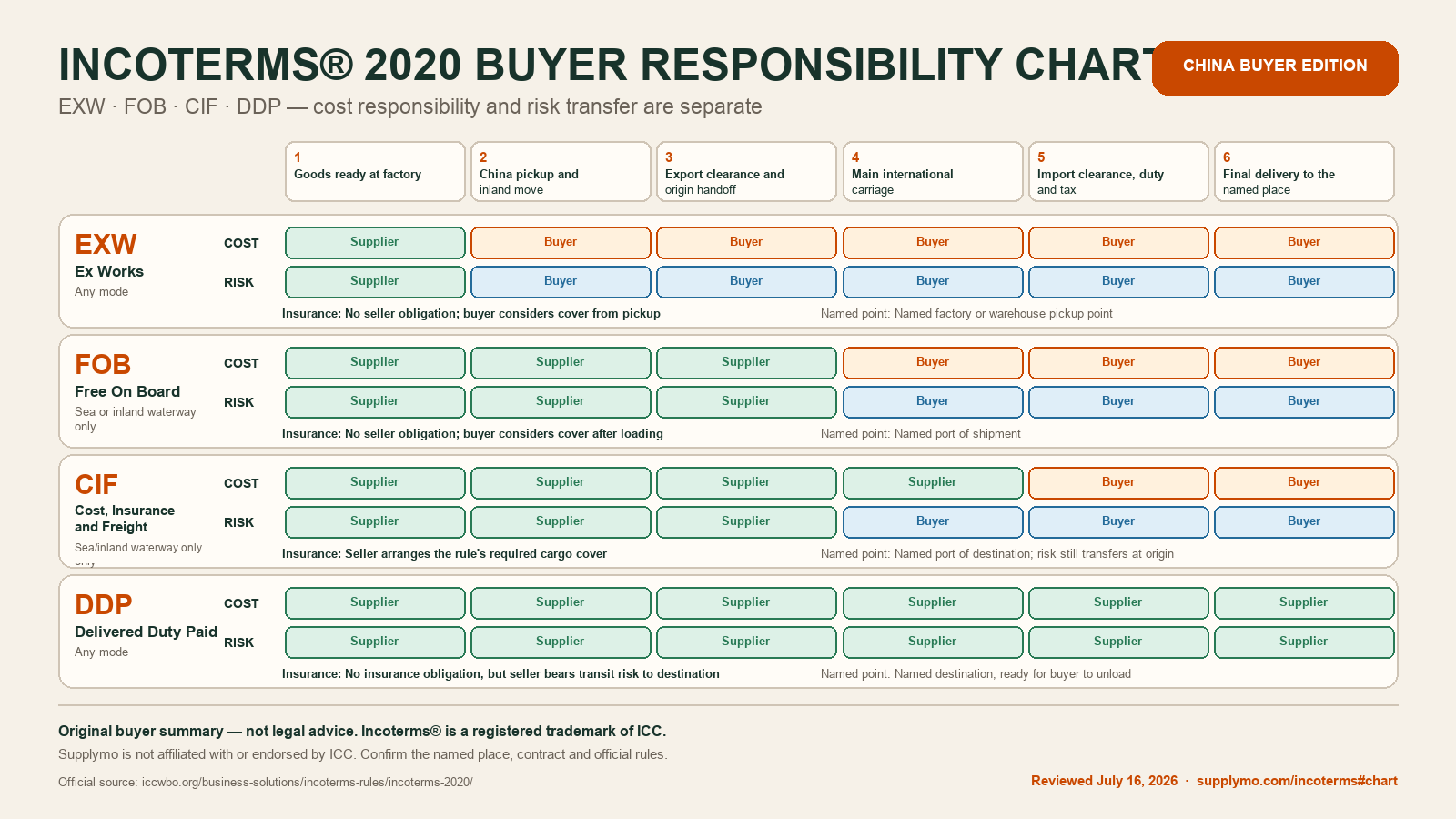
Incoterms® 2020 buyer responsibility chart

Read two tracks for each term: who pays through each stage, and who bears loss or damage risk. The four rules below expose the most common China-quote misunderstandings.

Supplier responsibility Buyer cost Buyer risk

Cost responsibility and risk transfer are separate. CIF makes that visible: the supplier pays main sea freight to the destination port, while transit risk transfers on board at origin.

EXWEx Works

Any mode · Named factory or warehouse pickup point

Seller makes the goods available at the named place. Buyer normally takes the transport chain and risk from pickup.

  1. 1Goods ready at factory
    Cost: supplierRisk: supplier
  2. 2China pickup and inland move
    Cost: buyerRisk: buyer
  3. 3Export clearance and origin handoff
    Cost: buyerRisk: buyer
  4. 4Main international carriage
    Cost: buyerRisk: buyer
  5. 5Import clearance, duty and tax
    Cost: buyerRisk: buyer
  6. 6Final delivery to the named place
    Cost: buyerRisk: buyer

Insurance: No seller obligation; buyer considers cover from pickup

FOBFree On Board

Sea or inland waterway only · Named port of shipment

Seller clears export and places the goods on board. Buyer takes cost and risk from the on-board handoff.

  1. 1Goods ready at factory
    Cost: supplierRisk: supplier
  2. 2China pickup and inland move
    Cost: supplierRisk: supplier
  3. 3Export clearance and origin handoff
    Cost: supplierRisk: supplier
  4. 4Main international carriage
    Cost: buyerRisk: buyer
  5. 5Import clearance, duty and tax
    Cost: buyerRisk: buyer
  6. 6Final delivery to the named place
    Cost: buyerRisk: buyer

Insurance: No seller obligation; buyer considers cover after loading

CIFCost, Insurance and Freight

Sea or inland waterway only · Named port of destination; risk still transfers at origin

Seller pays freight and arranges insurance to the destination port, while risk transfers when the goods are on board at origin.

  1. 1Goods ready at factory
    Cost: supplierRisk: supplier
  2. 2China pickup and inland move
    Cost: supplierRisk: supplier
  3. 3Export clearance and origin handoff
    Cost: supplierRisk: supplier
  4. 4Main international carriage
    Cost: supplierRisk: buyer
  5. 5Import clearance, duty and tax
    Cost: buyerRisk: buyer
  6. 6Final delivery to the named place
    Cost: buyerRisk: buyer

Insurance: Seller arranges the rule's required cargo cover

DDPDelivered Duty Paid

Any mode · Named destination, ready for buyer to unload

Seller carries the cost and risk to the named destination and is responsible for import clearance under the rule.

  1. 1Goods ready at factory
    Cost: supplierRisk: supplier
  2. 2China pickup and inland move
    Cost: supplierRisk: supplier
  3. 3Export clearance and origin handoff
    Cost: supplierRisk: supplier
  4. 4Main international carriage
    Cost: supplierRisk: supplier
  5. 5Import clearance, duty and tax
    Cost: supplierRisk: supplier
  6. 6Final delivery to the named place
    Cost: supplierRisk: supplier

Insurance: No insurance obligation, but seller bears transit risk to destination

Download the chart

Use the one-page buyer summary in a sourcing brief, training note or quotation review. The HTML chart above remains the accessible source.

Cite or embed

Copy a stable citation or a linked image snippet. The snippet keeps the explanatory source and legal boundary one click away.

Static image embed only. Supplymo does not require a followed backlink and does not relax main-site frame security.

The 1688 reality

Why your 1688 quote has no Incoterms® Rule

A 1688 listing or chat quote is usually written for a domestic China transaction. It may identify a factory price or China delivery point, but it does not become EXW, FOB or DDP until both parties agree the rule, the named place and the version in writing.

Domestic price, not an automatic trade rule

The listing may stop at the factory, a China warehouse or domestic delivery. That cost boundary can look EXW-like, but the contract still needs an agreed Incoterms® rule.

The export chain is still missing

Pickup, export clearance, carrier handoff, main freight, import, duty, tax and final delivery can sit outside the quoted number. Package data and cargo restrictions change those legs too.

Write three things before payment

Use the three-letter rule, an exact named place or port, and the version: for example, “FCA [named handoff place], Incoterms® 2020”. Then list any quote exclusions separately.

Start from the full chain when the quote has no agreed rule.

The landed-cost tool will show which origin, freight, import and delivery inputs are known, estimated or still missing.

Build the full cost stack

All 11 rules

Compare mode, freight, customs, insurance and risk

Use this table after the picker. A three-letter code without the exact named place is incomplete.

On a narrow screen, swipe inside the table. The page itself does not scroll sideways.

Supplymo summary of all 11 rules. Cost amounts and legal importer status are outside this table.
TermMode and best-fit clueMain freightExportImport duty / taxInsuranceRisk passes
EXWEx WorksAny modeA domestic 1688 price is not automatically an agreed EXW term.BuyerBuyerBuyerNo seller obligationWhen goods are placed at the buyer's disposal at the named pickup place
FCAFree CarrierAny mode; often suitable for containers and airCompare FCA before using FOB for container, air, courier or multimodal cargo.BuyerSellerBuyerNo seller obligationWhen delivered to the buyer's carrier at the named place
FASFree Alongside ShipSea or inland waterway onlyUsually relevant to bulk or project cargo, not a typical parcel or container handoff.BuyerSellerBuyerNo seller obligationWhen goods are placed alongside the vessel at the origin port
FOBFree On BoardSea or inland waterway onlyUse FOB for a real on-board sea handoff; containers delivered to a terminal often fit FCA better.BuyerSellerBuyerNo seller obligationWhen goods are on board the vessel at the origin port
CFRCost and FreightSea or inland waterway onlySeller-paid freight does not mean seller-held transit risk.SellerSellerBuyerNo seller obligationWhen goods are on board at origin, before the seller-paid freight ends
CIFCost, Insurance and FreightSea or inland waterway onlyConfirm the policy, insured value, exclusions and claims process; CIF cover is not unlimited.SellerSellerBuyerSeller arranges the cover required by the ruleWhen goods are on board at origin, before the seller-paid freight ends
CPTCarriage Paid ToAny modeThe cost endpoint and risk-transfer point are different.SellerSellerBuyerNo seller obligationWhen goods are delivered to the first carrier
CIPCarriage and Insurance Paid ToAny modeCIP requires broader default cover than CIF, but policy exclusions still matter.SellerSellerBuyerSeller arranges the cover required by the ruleWhen goods are delivered to the first carrier
DAPDelivered at PlaceAny modeDoor delivery can still leave import clearance, duty and tax with the buyer.SellerSellerBuyerNo seller obligation; seller bears transit risk to destinationAt the named destination, ready for the buyer to unload
DPUDelivered at Place UnloadedAny modeDPU is the only rule in which seller delivery includes unloading at destination.SellerSellerBuyerNo seller obligation; seller bears transit risk through unloadingAt the named destination after the seller unloads
DDPDelivered Duty PaidAny modeVerify that the seller can lawfully complete import formalities and identify the actual importer or declarant.SellerSellerSeller*No insurance obligation; seller bears transit risk to destinationAt the named destination, ready for the buyer to unload

Incoterms® 2020 allocate delivery, cost and risk responsibilities. They do not set freight prices, HS classification, duty or tax rates, title, payment terms or the legal importer of record.

* Under DDP, seller import responsibility is the allocation between the parties. Importer/declarant status and legal feasibility still require market-specific verification.

GEO-ready answers

What each Incoterm means for a China buyer

Each answer is a short, original operational summary. Follow the stable term anchor when you need the comparison row.

What does EXW mean?

EXW

Choose EXW only when your China-side team can collect the goods and manage the origin chain. The buyer normally takes cost and risk from the named pickup point, including loading and export arrangements. A 1688 listing price alone does not establish EXW: write the named place and Incoterms® 2020 into the contract.

What does FCA mean?

FCA

FCA is often the cleaner rule when your forwarder receives containerized, air, courier or multimodal cargo in China. The seller clears export and delivers to your nominated carrier at the named place; you arrange the main carriage. The precise handoff matters, so state the terminal, warehouse or other location rather than writing FCA alone.

What does FAS mean?

FAS

FAS is a specialist sea or inland-waterway rule. The seller clears export and places the goods alongside the vessel at the named origin port; the buyer takes the loading, main carriage and later costs. It is usually a poor fit for ordinary 1688 parcels or container handoffs, where FCA is more likely to match the operation.

What does FOB mean?

FOB

FOB means the seller clears export and places suitable sea cargo on board at the named origin port. The buyer then carries the main freight, destination charges, import and final delivery, and risk has already transferred. FOB is not an air-freight rule; for container delivery to a terminal, compare FCA with the actual handoff.

What does CFR mean?

CFR

CFR can match suitable sea cargo when the seller pays freight to the named destination port but does not arrange insurance under the rule. Risk transfers on board at origin, earlier than the paid freight ends. Confirm destination terminal charges, cargo cover, import clearance and final delivery instead of treating a CFR port price as landed cost.

What does CIF mean?

CIF

CIF adds seller-arranged cargo cover to a seller-paid sea-freight move, but risk still transfers when the goods are on board at origin. The buyer normally handles destination charges, import and final delivery. Ask for the insurance certificate, coverage level, exclusions and claims route; do not read CIF as guaranteed door delivery or complete protection.

What does CPT mean?

CPT

CPT works across transport modes when the seller pays carriage to a named destination. Risk usually transfers earlier, when the seller hands the goods to the first carrier, and seller-arranged insurance is not required by the rule. Confirm the first-carrier handoff, destination charges, import responsibility and any cargo cover before comparing the quote.

What does CIP mean?

CIP

CIP combines seller-paid carriage with seller-arranged insurance and can be used for container, air or multimodal cargo. Risk still transfers at the first-carrier handoff, not at destination. Ask for the policy details, insured value and exclusions, then separate import clearance, duty, tax and last-mile responsibilities from the seller's paid-carriage endpoint.

What does DAP mean?

DAP

DAP often fits a quote where the supplier carries the goods to your named address but you remain responsible for import clearance, duty and tax. The seller bears transit risk until the goods are ready for unloading at destination. Confirm who handles the customs broker, who unloads, and which destination or remote-area charges remain outside the quote.

What does DPU mean?

DPU

DPU extends seller delivery through unloading at the named destination. The buyer normally still handles import clearance, duty and tax, so an unloaded delivery promise is not automatically duty paid. Confirm that the destination can receive and unload safely, and write the exact terminal, warehouse or site rather than relying on a broad city name.

What does DDP mean?

DDP

DDP places the broadest delivery obligation on the seller, including import formalities and related charges as between the parties. It does not by itself prove who customs will recognize as importer of record in your market. Verify tax registrations, declared value, broker authority, documents and exclusions before treating a marketplace 'DDP' label as compliant all-in delivery.

Questions

Incoterms® 2020: common buyer questions

What are Incoterms in simple terms?

Incoterms® are standard ICC rules that allocate delivery tasks, transport costs and risk between seller and buyer. They do not set the product price, freight rate, tariff classification, duty rate, ownership of the goods, payment terms or the legal importer of record.

Which Incoterm do 1688 suppliers usually quote?

A domestic 1688 listing often has no agreed Incoterms® rule at all. It may show a factory price or China delivery boundary. If the order becomes an export, the parties still need to agree a three-letter rule, exact named place or port, and the version in writing.

Who pays import duty and VAT under each Incoterm?

As between seller and buyer, DDP assigns import formalities and related charges to the seller; the other rules normally leave import clearance and duty with the buyer. The actual importer, tax treatment and enforceability depend on the contract, local law, registrations and customs process.

What is the difference between FOB and DDP for China imports?

FOB is a sea or inland-waterway rule: the seller clears export and delivers suitable cargo on board at the named origin port, then the buyer takes freight, import and risk. DDP carries seller responsibility to a named destination, including import formalities as between the parties, subject to local-law feasibility.

Do Incoterms include insurance?

CIF and CIP require the seller to arrange specified cargo cover. Their default coverage levels differ, and neither removes policy exclusions or claims requirements. The other rules do not create a seller insurance obligation, so cover should be agreed separately according to who bears risk on each leg.

Can Supplymo tell me my exact landed cost from an Incoterm?

No Incoterm fixes a monetary total. Supplymo can structure the product, origin, freight, import and delivery inputs and identify missing evidence. Duty, VAT or GST, clearance, freight and delivery remain estimates until the product, route, documents and official destination-market treatment are confirmed.

Source and boundary

Use the official rules for the contract

Incoterms® is a registered trademark of the International Chamber of Commerce (ICC). Supplymo is not affiliated with or endorsed by ICC. This page is an original buyer-oriented summary, not the official rules or legal advice.

Reviewed July 16, 2026. Stable citation URL: supplymo.com/incoterms#chart.

Need the supplier’s rule checked before payment?

Send the product, quantity, destination and written quote scope. Supplymo checks the cost boundary, missing evidence and next decision without promising a fixed customs result.