
Every supplier hangs this document on a wall. Learn to read it.
The 营业执照 — the Chinese business license — answers most of “can I trust this company” in six fields.
Machine translation mangles exactly the fields that matter. We read these documents in Chinese every week; here is the document, dissected — with our own record as the worked example.

Liam Cai · Founder, Supplymo
Reads 营业执照 in Chinese every week · Yiwu, China
Business license · anatomy
营业执照
- 统一社会信用代码Unified Social Credit Code
- 91330782MAE50WWN6A
- 名称Registered name
- 义乌市连盈国际贸易有限公司
- 经营范围Business scope
- 货物进出口、技术进出口…
- 注册资本Registered capital
- —
- 成立日期Registration date
- 2024-11-29
- 登记状态Status
- 存续 (Active)
Sample values are Supplymo's own public record — type the code into gsxt.gov.cn and check us. That motion is the whole skill.
¥0
cost of the official registry (gsxt.gov.cn)
18
characters in every Unified Social Credit Code
3
names that must match before any payment
$199
what verification services charge for this
Try it now
Don't just read the steps — run the check
Paste a supplier's Chinese registered name and get the official registry snapshot: legal representative, capital, status, and business scope. Free, no login.
Check a company right here — free
Paste the exact Chinese legal name from the business licence. Confirm the result on the official GSXT registry before you rely on it.
Field notes
What each numbered field is telling you
And here is the physical document itself — our own license, photographed on our desk in Yiwu (watermarked copy). Every supplier you talk to has this exact document on a wall.
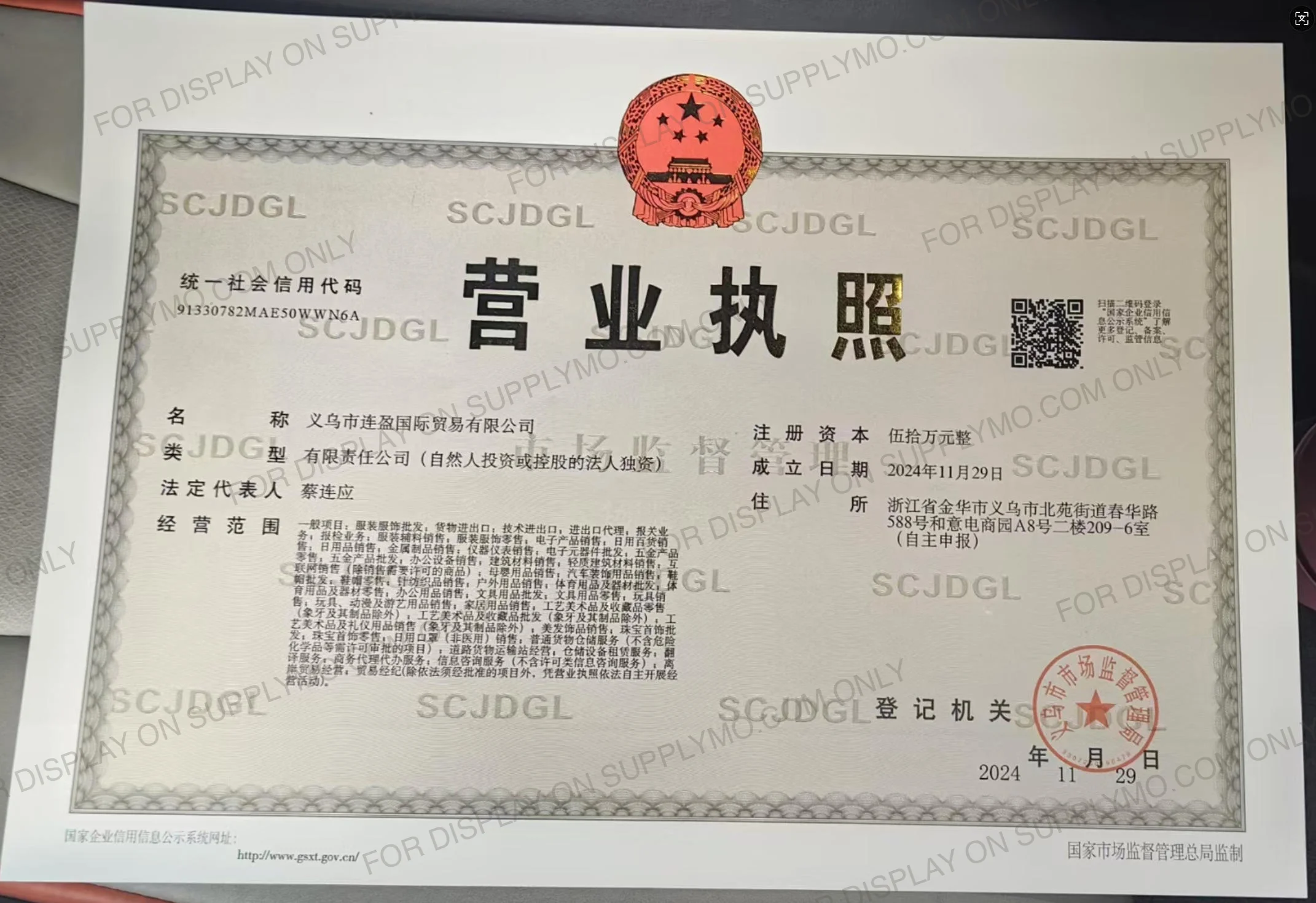
统一社会信用代码 · Unified Social Credit Code
The 18-character primary key of every Chinese company. Look it up on the official registry; use it to confirm two documents describe the same entity. (This sample code is ours — check us.)
名称 · Registered name
The legal name, in Chinese. This exact string — not the English trading name on the website — must match the contract and the bank beneficiary. English names are marketing; the Chinese name is the entity.
经营范围 · Business scope
What the company may legally do. 生产/制造 (manufacturing) = factory. 批发/贸易/进出口 (wholesale/trade) = trading company. A “manufacturer” profile with a trade-only scope is telling you something.
注册资本 · Registered capital
Declared, not deposited — a rough signal, not proof of size. ¥50,000 of registered capital claiming a 500-worker factory deserves questions.
成立日期 · Registration date
How long the entity has existed. Registered last month, selling every category at the best price — that is a pattern, not a coincidence.
登记状态 · Status
Must be 存续/在业 (active). 注销 (deregistered) or 吊销 (revoked) means the entity you are about to pay no longer legally operates.
The one unbreakable rule
Three names, one entity
License name
The same Chinese legal entity
Contract name
The same Chinese legal entity
Bank beneficiary
The same Chinese legal entity
Any mismatch → stop. No legitimate business reason produces one.
The procedure
Six steps from stranger to verified
Steps 1–4 are free and cover most of the risk. Steps 5–6 add depth for bigger commitments.
Ask for the business license
Free“Please send your business license (营业执照) — we verify all suppliers before payment.” A real supplier sends it in minutes; it hangs on their wall. Hesitation is an answer too.
Look the company up on gsxt.gov.cn
FreeThe National Enterprise Credit Information Publicity System — the government source, free, no login. Search the Chinese name or the 18-character code. Confirm active status, sensible scope, matching legal representative.
Read the scope: factory or trader?
FreeManufacturing scope = factory. Trade-only scope = middleman. Middlemen take small orders factories reject — fine, as long as you know which margin you are paying and who controls quality.
Match the three names
FreeLicense = contract = bank beneficiary. Same legal entity or you stop — the strongest single signal in China sourcing.
Cross-check an aggregator (bigger orders)
OptionalTianyancha (天眼查) / Qichacha (企查查) add court cases, penalties, and ownership history on top of the official record. Chinese-only interfaces; the free registry already answers the core question.
Verify the goods, not just the paperwork
OptionalDocuments prove an entity exists — not that your batch is right. Dated photo of your product now; a pre-shipment inspection in China for meaningful orders.
Watch the motion
The lookup, screenshotted — on our own record
This is the exact search from steps 1–2, run against Supplymo's own company on the official registry. Same screens you'll see for any supplier — search, result, full license record.
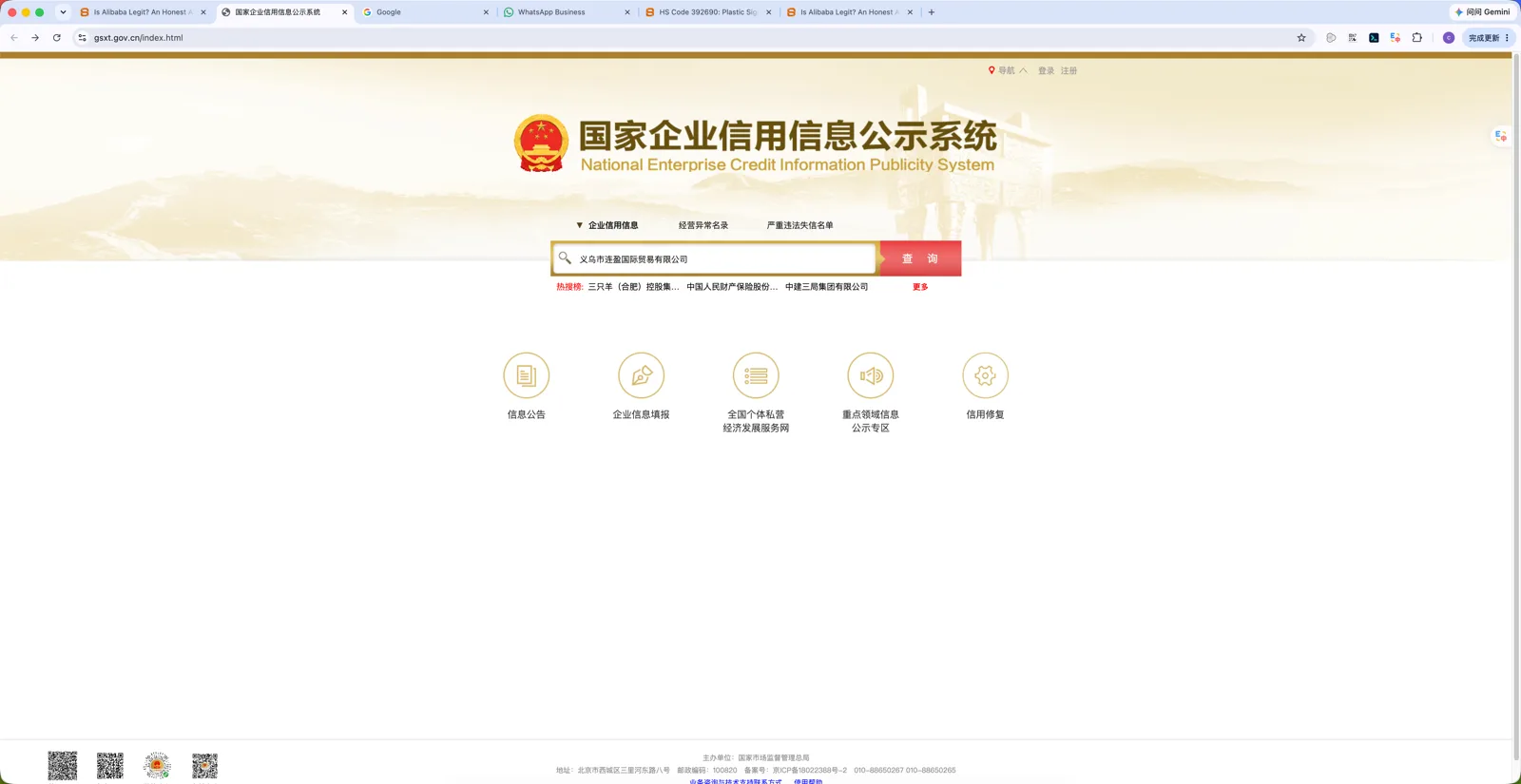
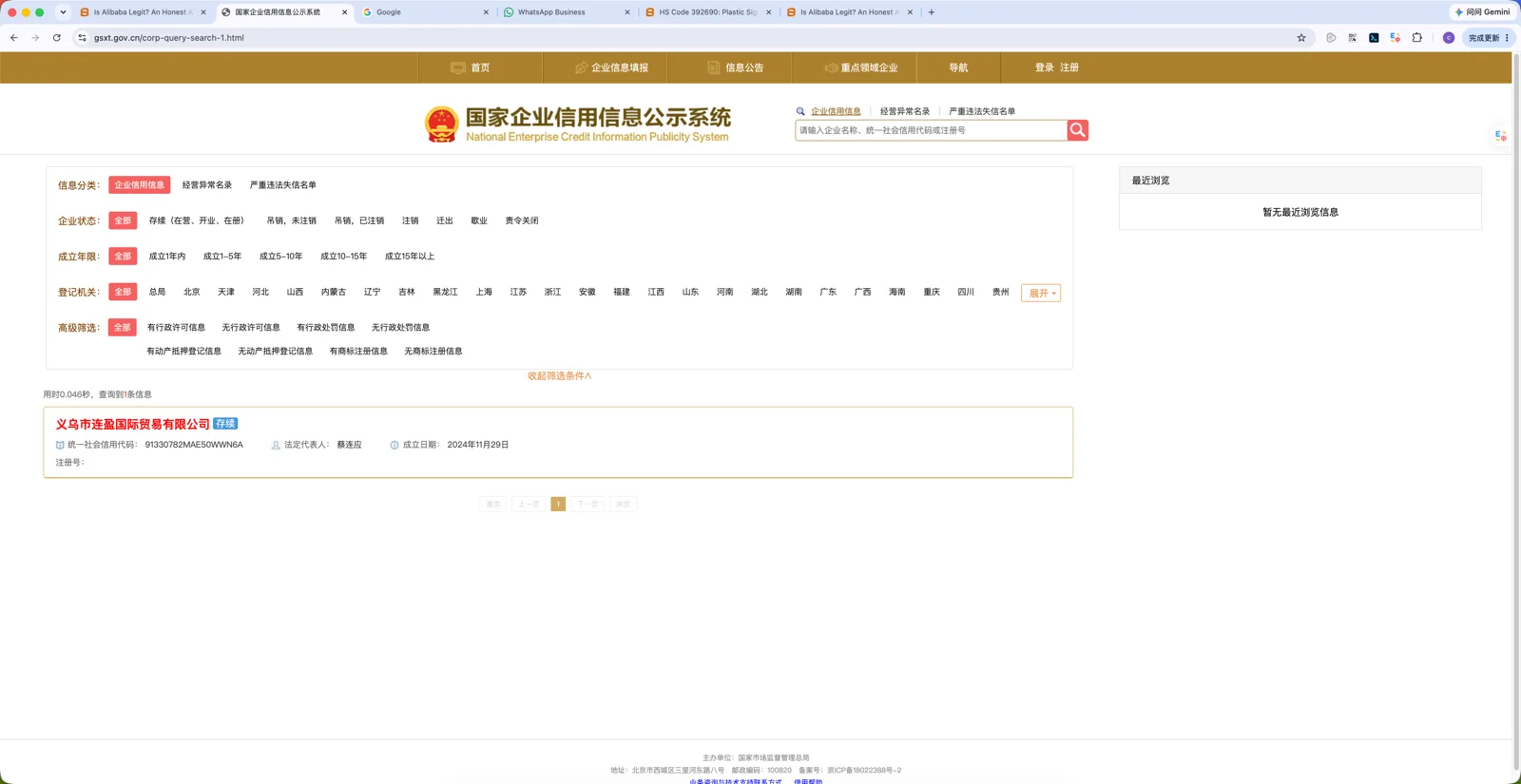
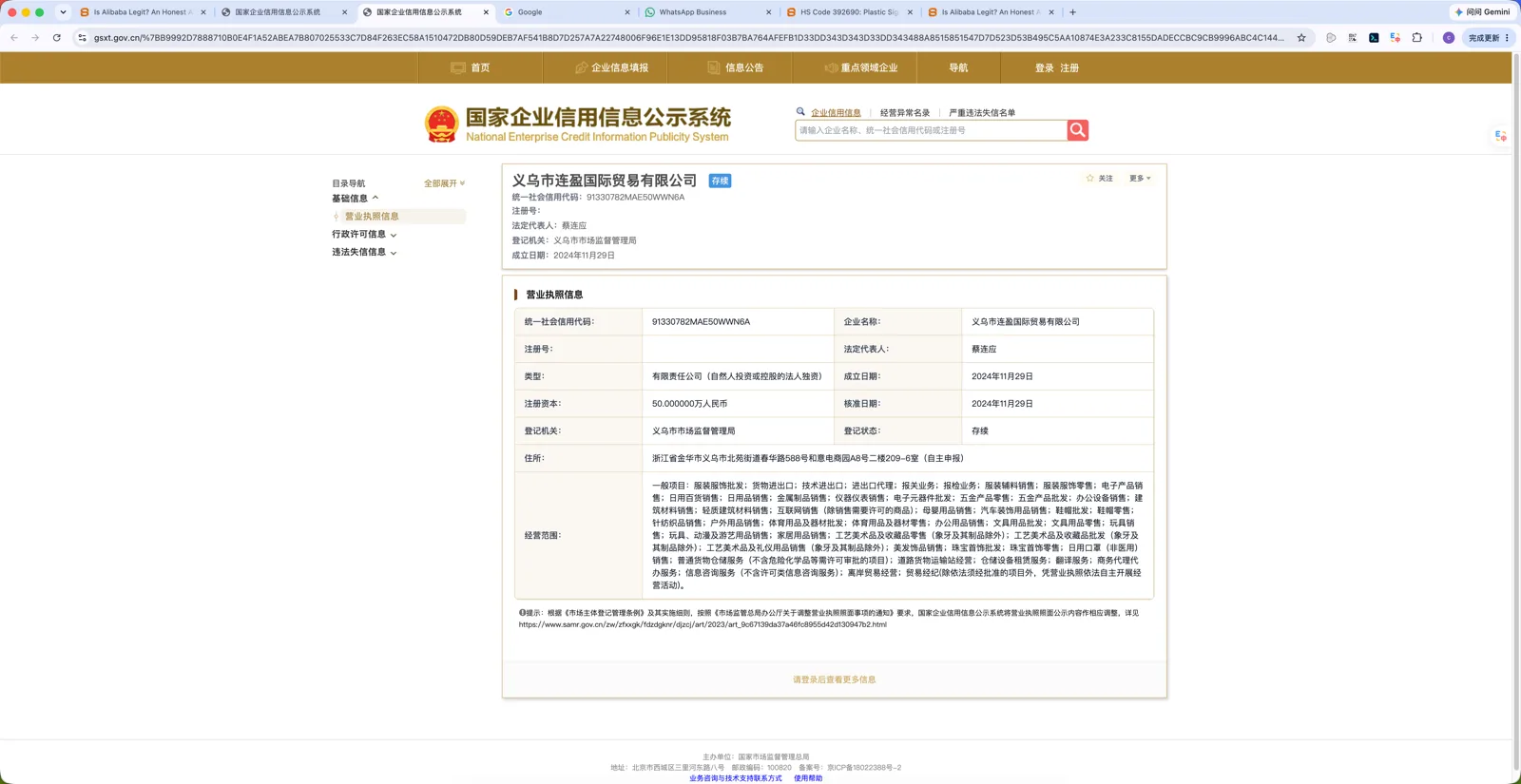
Free, no login, takes about a minute once you have the license name. If the record doesn't exist, isn't active, or the scope doesn't match what they sell you — that's your answer before any money moves.
Paper catches
Fake companies. Revoked entities. Wrong payees. Traders posing as factories.
Identity fraud dies at the registry. That is most scams, most of the time, for free.
Paper cannot catch
What's inside carton 14 of 20. Licenses can be borrowed; cartons can't lie in person.
For meaningful orders, the last layer is physical: a pre-shipment inspection in China before the goods fly. That layer is what we exist for.
Questions
Verification: what buyers ask us
How do I verify a Chinese supplier before paying?
Ask for the business license, verify it on the official registry (gsxt.gov.cn), read the business scope to see if they are a factory or trading company, and confirm the license name matches the bank beneficiary name. All of this is free and takes under an hour. For larger orders, add a physical check of the goods in China before shipping.
Is there a free way to check a Chinese company?
Yes. The National Enterprise Credit Information Publicity System (gsxt.gov.cn) is the official government registry and costs nothing. It shows registration status, business scope, registered capital, legal representative, and administrative penalties. Commercial services largely repackage this record with extra data layers.
How does Alibaba supplier verification work — is a 'Verified Supplier' badge enough?
Alibaba's Verified Supplier badge means a third party inspected the company on Alibaba's behalf — useful, but it verifies the account holder, not your specific transaction. Independent verification is still worth the hour: pull the business license, check it on gsxt.gov.cn yourself, and confirm the bank beneficiary matches the licensed name. Badge plus registry match plus name match is a defensible basis to pay; a badge alone is not.
How do I check a Chinese business license is real?
Take the 18-digit Unified Social Credit Code from the license and search it on gsxt.gov.cn, the official registry. The registry record should match the license on company name, legal representative, and business scope, and show status 存续 (active). A license that is real but belongs to a different company than the one you are paying is the more common fraud — which is why the name-match rule matters more than the paper.
What is Tianyancha and can I use it in English?
Tianyancha (天眼查) is a commercial Chinese business-data aggregator built on official records plus litigation, penalties, and ownership graphs. The interface is Chinese-only; browser translation works but field names translate awkwardly. For most pre-payment checks, the official registry answers the core question — aggregators add depth for bigger commitments.
Is a business license enough to trust a supplier?
No. A license proves a legal entity exists and what it may do — it does not prove the goods will match, and licenses can be borrowed for a storefront. Treat document checks as the floor: they stop identity fraud. Product and batch checks (samples, dated photos, pre-shipment inspection) stop the expensive problems.
Why do verification services charge $199 for this?
Convenience and packaging: they read the same official registry, translate it, and add litigation and credit layers into a PDF. That has value if you cannot read Chinese — but the core check is free, and this page shows the steps. Supplymo runs it as part of every product check, alongside the product and cost review.
Does verification guarantee the supplier is safe?
No — and be wary of anyone who says otherwise. Verification removes the identity risks: fake companies, revoked entities, wrong payees, traders posing as factories. Quality, batch, and shipping risks need written specs and China-side checks. It is a layered defense, not a certificate.
Want the whole check run for you?
Send the supplier or product link. We verify the license, scope, and name match, source-match the product, and put the real landed cost against your target — returned as a written decision before you pay.