
0% commission buying agent vs managed sourcing: what each costs on the same order
Where a 0% self-service platform earns its money, what a managed fee buys, and the two compared on four order sizes.
 Liam Cai · Founder, SupplymoPublished · Updated · 6 min read
Short answer
A 0% commission buying agent charges no service fee because you do the sourcing yourself. You pick the 1688 listing and check the seller. Any problem goes through the platform's support. A managed sourcing service charges a share of the goods value instead. Ours is 5% stepping down to 3% with a $49 minimum, and for that we find the supplier and negotiate in Chinese.
What does 0% commission actually cover?
We are a sourcing agent ourselves, and Supplymo wrote this guide. We charge a percentage on sourcing. Read the numbers below knowing that. We also run a self-serve Shop with no service fee. So we sell both models.
On a 0% platform the zero applies to the service fee on orders you place yourself. You paste a 1688 link or search inside the site and pay the listed price plus domestic shipping. The platform then buys the goods and receives them at its warehouse. Nobody compares suppliers for you or asks for a better price at your quantity.
The platform still has to earn money somewhere. Before you compare it with anyone else, find these lines on its price list:
- International freight. After the goods, it is usually the biggest line on the order.
- The exchange rate used when you top up or pay, and any margin on it.
- Paid extras such as extra photos, inspection beyond a count, repacking and labels.
- Storage once the free period ends.
- Paid tiers or a membership that unlock help from a person.
- A percentage that starts once you use their consolidation or forwarding. Some platforms charge it on the free plan too.
That is a normal way to run a platform. It means the useful comparison is the total you pay per order, not the word commission.
How do buying agents charge?
| Model | What you pay on top of goods and freight | Who does the sourcing work |
|---|---|---|
| Self-service, 0% commission | Extras you choose, storage after the free period | You |
| Monthly membership | A fixed monthly fee, often with a minimum term | Depends on the plan. Often a person helps once you pay |
| Managed sourcing | A share of the goods value, usually with a minimum per order | The agent |
A membership is easy to test with one division. Divide the monthly fee by the percentage you would otherwise pay. The result is the monthly spend where the two cost the same. As an illustration, a $100 membership against a 5% fee breaks even at $2,000 of goods a month. Below that, the percentage costs less.
Count the minimum term as well. If the plan runs for at least two months, a quiet month still costs the full fee.
Example: what each model charges on four order sizes
These orders are hypothetical, assumed for illustration. A buyer wants three products from three different 1688 suppliers, shipped together. The goods values below are the totals for all three. Freight and duty are left out because they depend on the products and the route, and they apply under every model.
| Goods value | 0% self-service | Paid managed tier at 5%, $50 minimum | Supplymo sourcing fee | Supplymo follow-up, your supplier (3%) |
|---|---|---|---|---|
| $800 | $0 | $50 | $49 (6.1%) | $49 |
| $3,000 | $0 | $150 | $150 (5%) | $90 |
| $12,000 | $0 | $600 | $530 (4.4%) | $360 |
| $30,000 | $0 | $1,500 | $1,150 (3.8%) | $900 |
To check the $12,000 row: 5% of $5,000 is $250, plus 4% of $7,000 is $280. That makes $530, about 4.4% of the goods. The $30,000 row works the same way: 5% of $5,000 is $250, plus 4% of $15,000 is $600, plus 3% of $10,000 is $300, which adds up to $1,150.
At $800 the minimum fee applies. 5% would be $40, so the fee rises to the $49 minimum. That is 6.1% of the goods. The 0% route usually wins on fees for a small order of stock items you have already picked.
At $3,000 the gap is $150. That is the number to weigh against the work in the next section, since the freight and duty on top are the same either way.
What do you do yourself on a 0% platform?
The fee column is the easy part to compare. The same three-supplier order also needs the jobs below done by someone.
| Job | 0% self-service | Managed sourcing |
|---|---|---|
| Find and compare suppliers for each product | You, in Chinese or through a translator | The agent, with the supplier price shown on the quote |
| Check that each seller is a registered company | You | The agent |
| Get a price at your quantity, not the listed tier | You, or you pay the listed price | The agent, in Chinese |
| Confirm color, size, material and packaging in writing | You, in the order notes | The agent, with the supplier |
| Chase a supplier who is late | You, through the platform's support | The agent |
| Check the goods when they arrive | Depends on the platform. Some include a basic sample check, deeper checks are paid | Counted and photographed. Inspection is quoted if you want it |
| Combine the three suppliers into one shipment | The platform's warehouse | The agent's warehouse or partner warehouse |
| Sort out a wrong or short delivery | You raise it, the platform passes it on | The agent, with the seller |
Most of those rows take little time if you already know the product and the seller. With a new product from a supplier you have never used they are most of the job. Much of it happens in Chinese.
If you go the self-service way, these guides cover the checks you will be doing: Check a Chinese company on the official registry·Ask for the price at your quantity
When is a managed fee worth paying?
A managed fee rarely pays back through a lower price alone. It pays back when something goes wrong. Say one of the three suppliers in the example ships the wrong color. On a self-service order you report it and the seller decides whether to accept it. If they do, the replacement goes back through domestic shipping and the warehouse again.
What that costs depends on the seller and the goods. The delay can matter more than the money when the stock was meant for a sales season or a launch date.
So on the $3,000 order, compare $150 with the cost of one bad batch, not with zero. The fee buys you little if you trust the listing and the seller. It is cheap cover when you have never bought from them.
Which one should you pick?
- Pick a 0% platform when the items are stock goods, you already have the links and you can read a 1688 listing, even through a translator.
- Pick managed sourcing when you need a supplier found or a custom spec agreed. It also makes sense when every supplier on the order is new to you.
- If you already have a supplier and only need the order placed and followed to the warehouse, a follow-up fee such as our 3% sits in between.
On our quotes the supplier price, our fee and the exchange rate each sit on their own line. No markup on supplier prices, and no supplier kickbacks. If you pay in USD or another currency, we convert at the mid-market rate at the time of the quote, less 2% to cover currency costs. Both rates are written on your quote and stay fixed for 7 days.
Ask any agent, 0% or not, for the same breakdown before you compare totals.
Questions
Is a 0% commission buying agent really free?
The service fee on orders you place yourself is zero. You still pay freight. Depending on the platform you may also pay for extras or for storage after the free period, and the exchange rate may carry a margin. Compare the total per order.
How is a banded fee different from a flat percentage?
Each rate applies only to the part of the order inside its band. On $6,000 of goods, 5% of $5,000 is $250 and 4% of $1,000 is $40, so the fee is $290. Crossing into a lower band never raises the rate on the part below it.
Can I use a 0% platform and still have the supplier checked?
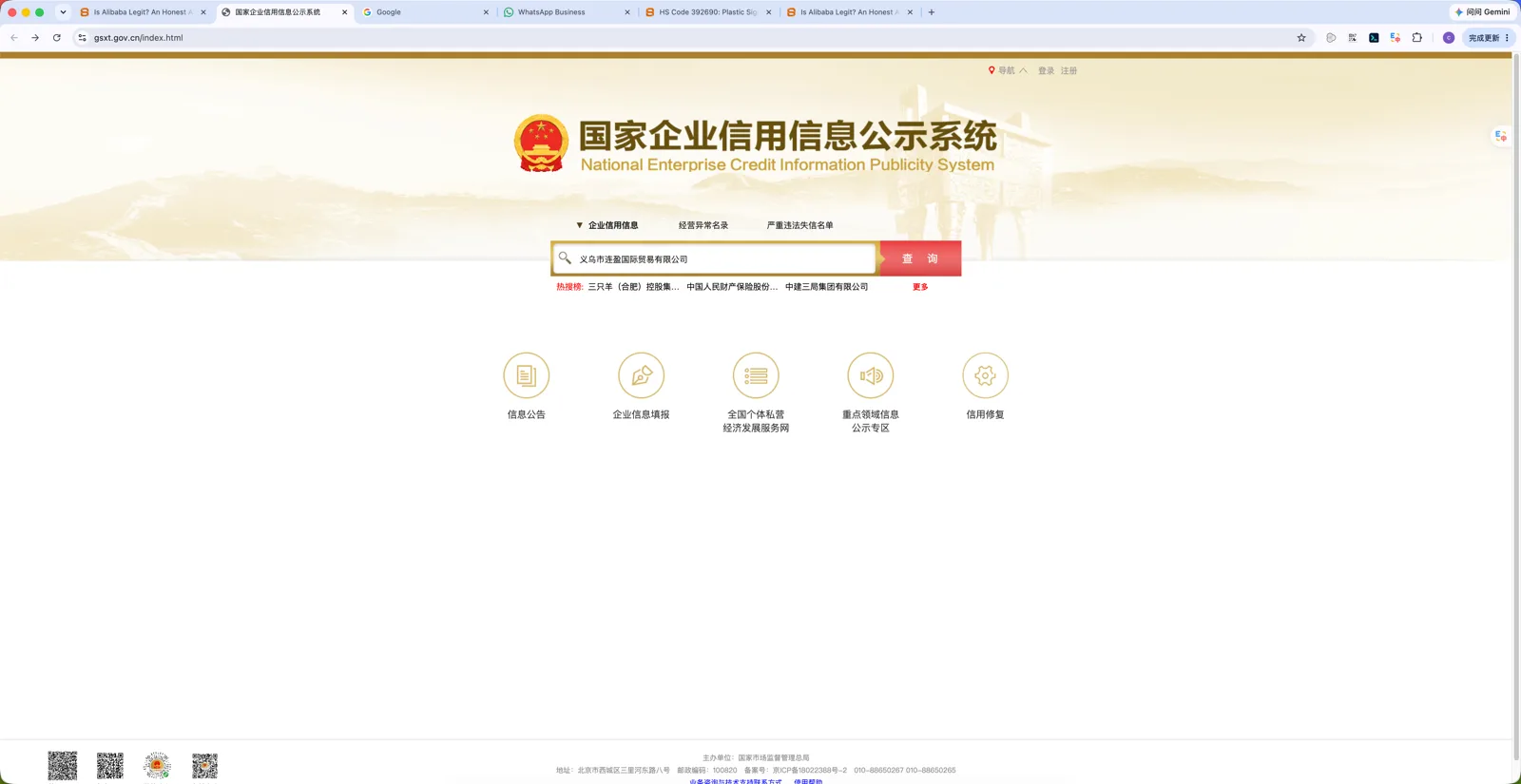
Yes. You can look the company up yourself on China's official business registry, or ask an agent to check the seller and the listing before you order. Our supplier check is free.
Do you charge a service fee on samples?
Ordering samples only? There is no service fee. You pay the sample price and the shipping.
Related reading
All guides →
Alibaba vs 1688: prices, MOQ, payment and when to use an agent
Prices, MOQ and payment on both sites, and when buying from 1688 through an agent makes sense.

Landed cost: what it includes and how to calculate it for goods from China
The landed cost formula with one worked example, plus the US and EU checks that change your duty.
Chinese company verification
How to read a Chinese business license and look the company up for free on the official registry, gsxt.gov.cn.