
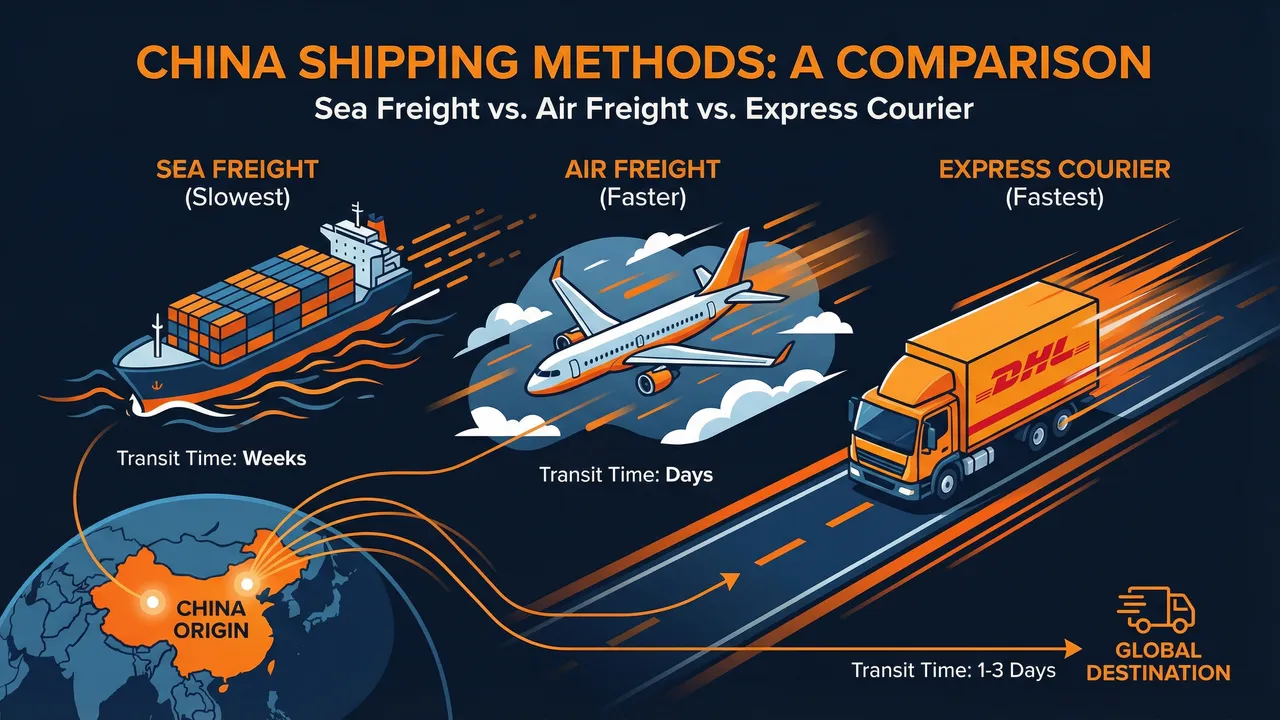
You've found a supplier, negotiated a price, and approved your samples. Now comes the question that determines whether your margins survive: how do you actually ship it?
Choosing the wrong shipping method can erase 15+% of your profit margin - or worse, leave your inventory sitting at a port while your competitors sell through peak season. The three main options - sea freight, air freight, and express courier - each have radically different cost structures, transit times, and risk profiles. Before reading, make sure you understand how customs clearance works.
This guide breaks down each method with real 2026 rates so you can make the right call for your specific shipment.
Key Takeaways
- Sea freight is cheapest for shipments over 2 CBM (~500 kg), costing $1,400+ per container to the US
- Air freight hits a sweet spot for 100+ kg shipments at $4+/kg with 5-7 day transit
- Express (DHL/FedEx/UPS) wins for under 100 kg at $7.50+/kg with 2-3 day delivery
- Your breakeven point between methods depends on product weight, value, and time sensitivity
- FOB is the most common Incoterm - it gives you control over shipping costs
The Three Shipping Methods at a Glance
| Factor | Sea Freight | Air Freight | Express Courier |
|---|---|---|---|
| Cost range | $1,400+ (20GP FCL) | $4+/kg standard | $7.50+/kg |
| Transit time | 25+ days | 5-7 days | 2-3 days |
| Best for weight | 500+ kg / 2+ CBM | 100+ kg | under 100 kg |
| Tracking | Port-to-port | Airport-to-airport | Door-to-door |
| Customs | You arrange (or broker) | You arrange (or broker) | Courier handles it |
| Insurance | Separate policy needed | Separate policy needed | Included (basic) |
| Minimum shipment | 0.5 CBM (LCL) | 45 kg | 0.5 kg |
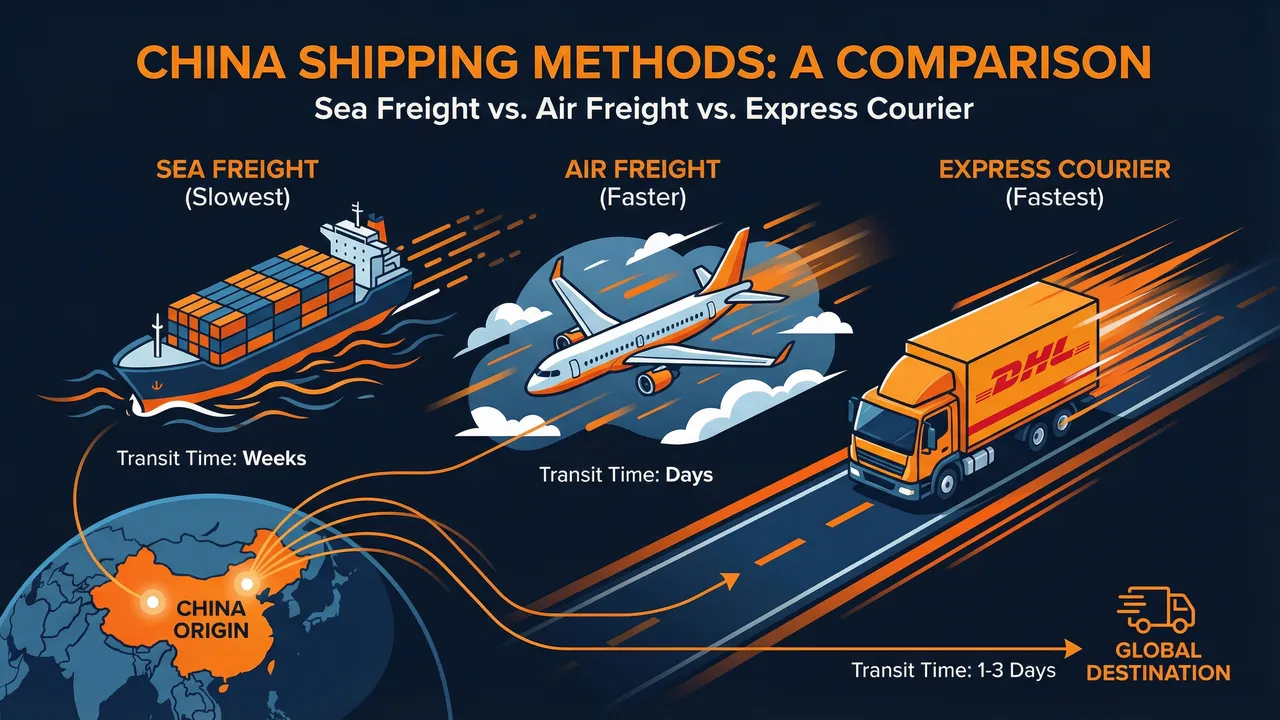
Sea Freight: The Workhorse for Bulk Shipments
Sea freight carries over 80% of global trade by volume according to UNCTAD's Review of Maritime Transport. If you're importing anything heavier than 500 kg or larger than 2 CBM, this is almost certainly your cheapest option.
FCL vs LCL: Two Sub-Options
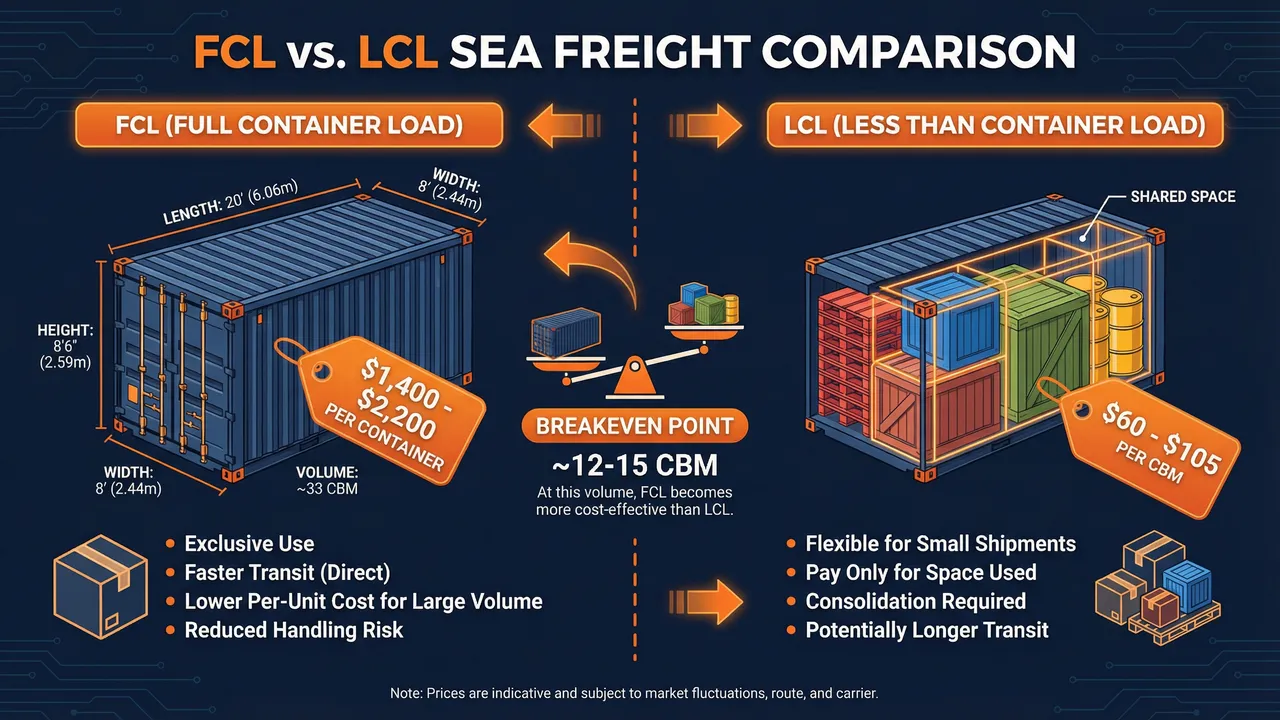
FCL (Full Container Load) - you rent the entire container. Nobody else's goods are inside.
| Container Type | Internal Dimensions | Capacity | 2026 Rate (China to US West Coast) |
|---|---|---|---|
| 20GP | 5.9m x 2.35m x 2.39m | ~33 CBM / 25 tons | $1,400+ |
| 40GP | 12m x 2.35m x 2.39m | ~67 CBM / 26 tons | $2,500+ |
| 40HQ | 12m x 2.35m x 2.69m | ~76 CBM / 26 tons | $2,700+ |
LCL (Less than Container Load) - your goods share space with other shippers' cargo.
| Route | Rate per CBM | Min charge | Transit time |
|---|---|---|---|
| China to US West Coast | $60+/CBM | 1 CBM | 28+ days |
| China to US East Coast | $80+/CBM | 1 CBM | 33+ days |
| China to Europe | $50+/CBM | 1 CBM | 30+ days |
Supplymo Insight: The breakeven point between LCL and FCL is usually around 12+ CBM. Above that, a 20GP container is almost always cheaper. We've seen first-time importers pay $1,800/CBM in LCL fees for a 14 CBM shipment - when a 20GP container would have cost $1,600 total. Always calculate both options. Use our Shipping Calculator to compare LCL vs FCL instantly for your shipment size.
Sea Freight Cost Components
The container rate is just the starting point. Here's what you'll actually pay:
| Component | Typical Cost | Who Pays (FOB) |
|---|---|---|
| Ocean freight (container rate) | $1,400+ | Buyer |
| Origin handling (THC) | $100+ | Seller |
| Destination handling (THC) | $200+ | Buyer |
| Customs brokerage | $150+ | Buyer |
| Drayage (port to warehouse) | $200+ | Buyer |
| ISF filing (US only) | $25+ | Buyer |
| Bond (US only) | $50+/year | Buyer |
| Chassis fee | $30+/day | Buyer |
| Total additional charges | $655+ | N/A |
When to Choose Sea Freight
- Shipments over 2 CBM or 500 kg
- Non-urgent inventory replenishment (plan 6-8 weeks ahead)
- Heavy, bulky, or low-value goods where per-unit shipping cost matters
- Not for time-sensitive restocking or product launches
Air Freight: The Middle Ground
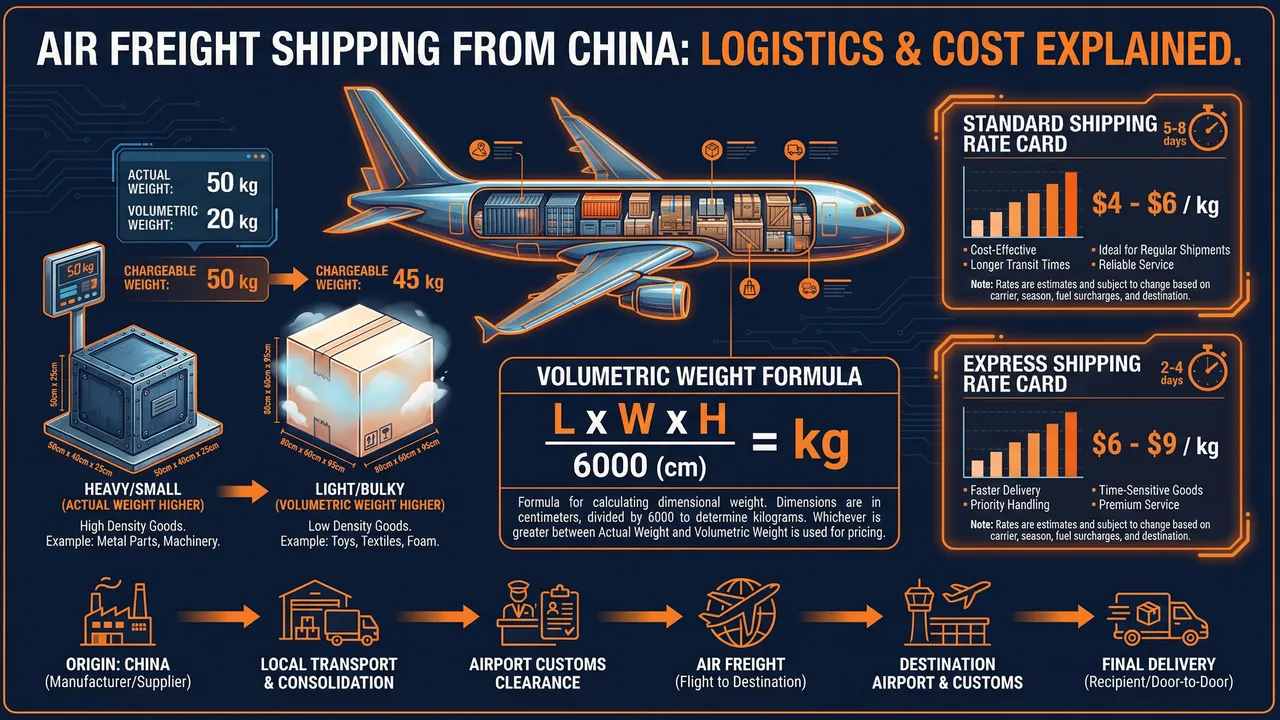
Air freight fills the gap between slow-but-cheap sea freight and fast-but-expensive express. Standard air cargo takes 5-7 days from departure to arrival at your destination airport.
2026 Air Freight Rates from China
| Route | Standard Cargo (5-7 days) | Express Air (3-5 days) |
|---|---|---|
| China to US West Coast | $4.00+/kg | $6+/kg |
| China to US East Coast | $4.50+/kg | $7+/kg |
| China to Europe | $4.00+/kg | $6+/kg |
| China to UK | $4.50+/kg | $6.50+/kg |
Actual vs Volumetric Weight
Airlines charge based on chargeable weight - whichever is higher between actual weight and volumetric weight. This catches many first-time importers off guard.
Volumetric weight (kg) = Length (cm) x Width (cm) x Height (cm) / 6,000
Example: A box measuring 60cm x 40cm x 40cm weighing 8 kg:
- Volumetric weight: 60 x 40 x 40 / 6,000 = 16 kg
- Actual weight: 8 kg
- Chargeable weight: 16 kg (volumetric is higher)
At $5/kg, you'd pay $80 instead of the $40 you might have expected. For lightweight, bulky products (plush toys, plastic containers, pillows), this can double your shipping cost.
Supplymo Insight: The volumetric weight trap is the #1 reason Amazon FBA sellers blow their shipping budget on air freight. We had a client shipping LED strip lights - actual weight 180 kg, but volumetric weight was 420 kg because the packaging was bulky foam boxes. The fix? We switched to vacuum-sealed flat packaging and got the volumetric weight down to 210 kg. That one packaging change saved $1,050 per shipment. Always ask your supplier to minimize packaging dimensions, not just protect the product.
When to Choose Air Freight
- Shipments between 100+ kg
- Product launches where speed matters
- High-value goods (electronics, cosmetics) where fast delivery protects margins
- Emergency restocking when sea freight would mean stockout
- Not for heavy, low-value goods (furniture, ceramics, metals)
Express Courier: Fast, Simple, Expensive
Express services (DHL, FedEx, UPS, TNT) handle everything: pickup from the supplier's warehouse, customs clearance, and delivery to your door. The simplicity comes at a premium.
2026 Express Rates from China to US
| Weight Range | DHL | FedEx | UPS |
|---|---|---|---|
| 1-3 kg | $11+/kg | $10+/kg | $10+/kg |
| 5+ kg | $9+/kg | $8+/kg | $8.50+/kg |
| 20+ kg | $8+/kg | $7.50+/kg | $7.50+/kg |
| 50+ kg | $7.50+/kg | $7+/kg | $7+/kg |
Express couriers also use volumetric weight calculations, but with a divisor of 5,000 (not 6,000 like air freight), making it even more punishing for bulky items.
Hidden Express Costs
- Fuel surcharge: 15+% added to the base rate (fluctuates monthly)
- Remote area surcharge: $3+/kg for addresses outside metro areas
- Residential delivery fee: $3+ per package (DHL, FedEx)
- Customs brokerage: Usually included, but verify - some couriers charge extra for formal customs entries (shipments over $2,500 to the US)
When to Choose Express
- Samples (1+ kg)
- Urgent shipments under 100 kg
- Small, high-value items (jewelry, electronics, watches)
- First orders from new suppliers (quick turnaround to test quality)
- Never for bulk inventory - even a modest 300 kg shipment at $9/kg = $2,700, versus $1,600 for a full sea freight container
Side-by-Side Cost Comparison: Same Product, Three Methods
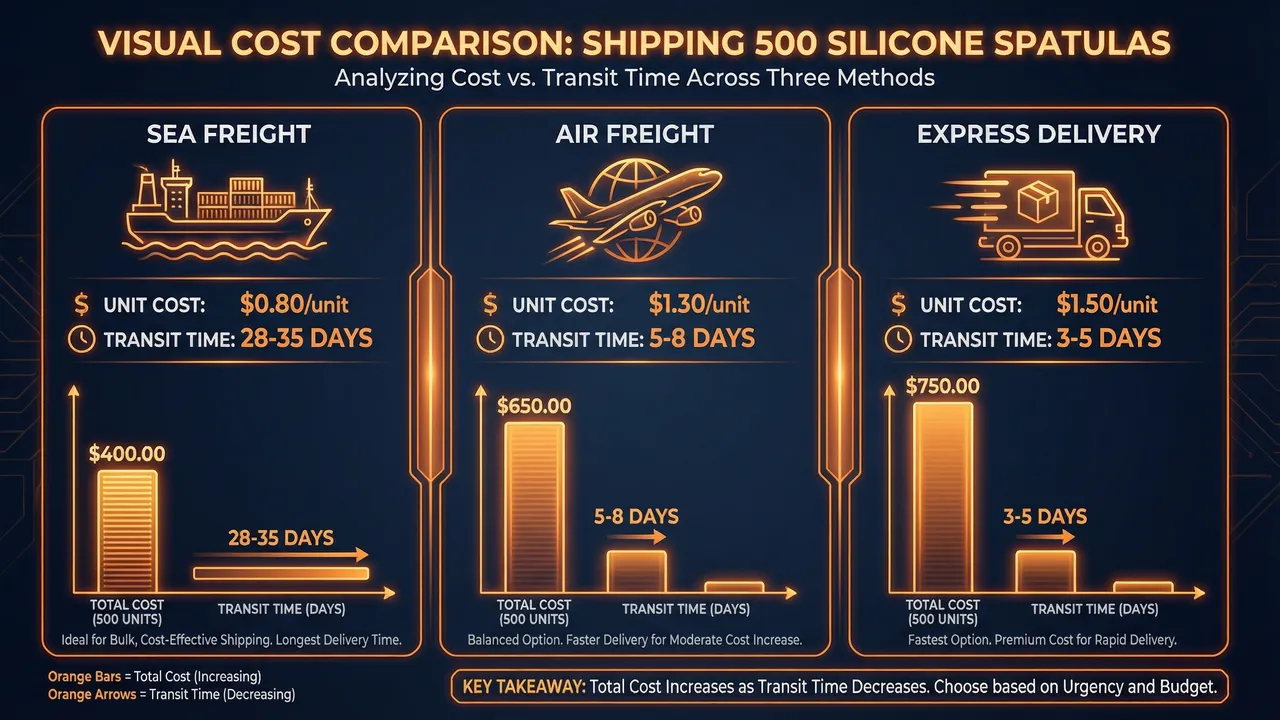
Let's compare shipping a real product: 500 units of silicone kitchen spatulas from Ningbo to Los Angeles.
Product specs: Each unit weighs 200g, dimensions 32x8x3 cm, carton of 50 units = 10 kg, 40x35x35 cm.
| Metric | Sea (LCL) | Air Freight | Express (DHL) |
|---|---|---|---|
| Total weight | 100 kg | 100 kg | 100 kg |
| Total volume | 0.49 CBM (10 cartons) | 0.49 CBM | 0.49 CBM |
| Chargeable weight | 0.49 CBM | 100 kg (actual > vol) | 100 kg |
| Shipping cost | $49+ | $400+ | $750+ |
| Customs/handling | $200+ | $200+ | Included |
| Drayage/delivery | $150+ | $50+ | Included |
| Total landed | $399+ | $650+ | $750+ |
| Per unit | $0.80+ | $1.30+ | $1.50+ |
| Transit time | 28+ days | 5-7 days | 3-5 days |
Supplymo Insight: Notice how LCL becomes surprisingly competitive once you add up all the ancillary costs for air and express. For this particular shipment (0.49 CBM, 100 kg), the air freight total is about 2x the sea freight total - but you get it 3 weeks faster. The decision comes down to one question: is 3 weeks of lost sales worth $350+? For a product selling 10 units/day at $5 profit each, 3 weeks = $1,050 in lost profit. In that case, air freight pays for itself. For a slow-selling product at 2 units/day, it doesn't.
Incoterms That Matter: FOB, CIF, and DDP
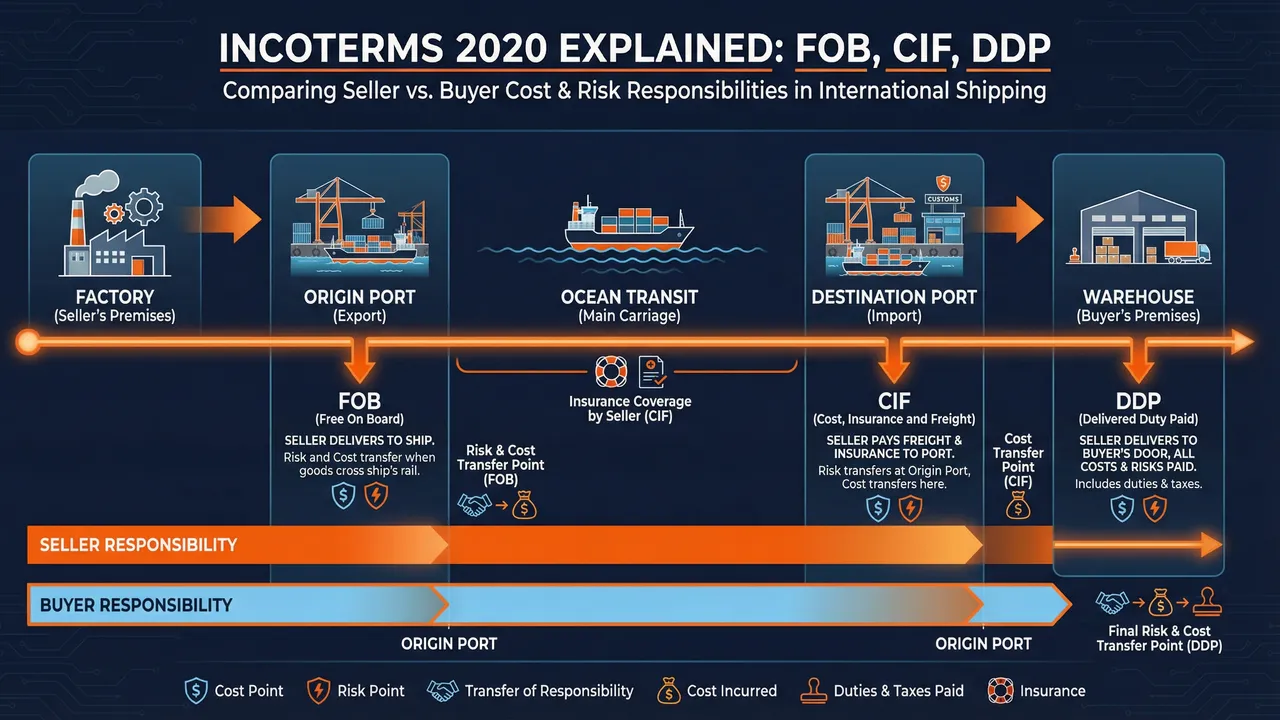
Incoterms determine who pays for what, and where risk transfers from seller to buyer. Three dominate China sourcing:
FOB (Free On Board) - The Standard Choice
- Seller handles: Production, domestic transport, export customs, loading onto ship
- Buyer handles: Ocean freight, insurance, import customs, destination delivery
- Risk transfers: When goods cross the ship's rail at the origin port
Why FOB is recommended: You control the shipping - you choose the freight forwarder, negotiate rates, and avoid supplier markup on logistics. Over 70% of experienced importers use FOB.
CIF (Cost, Insurance, Freight)
- Seller handles: Everything FOB covers + ocean freight + basic insurance
- Buyer handles: Import customs, duties, destination delivery
The CIF trap: Suppliers inflate the CIF price by 20+% over FOB + your own shipping costs. The "included insurance" is usually minimal ($500 total coverage). It feels convenient, but you lose transparency and pay more.
DDP (Delivered Duty Paid)
- Seller handles: Everything, including import customs and duties
- Buyer handles: Nothing - just receive the goods
Best for: Beginners doing small trial orders. Worst for: Anyone importing regularly, because you surrender all control.
When to Switch Methods: Volume Thresholds
Mixed Shipping Strategy
Smart importers don't pick one method - they use a combination:
- Launch stock: Air freight to get products listed fast, start generating sales
- Replenishment stock: Sea freight arrives 3-5 weeks later at lower cost
- Emergency restock: Express freight when you're about to stock out and can't wait
This "fast-then-slow" approach minimizes both cost and stockout risk. For Amazon FBA sellers, it's nearly mandatory.
How to Get Shipping Quotes
Freight Forwarder Quotes (Sea + Air)
Contact 3-5 freight forwarders with this information:
- Origin: City and port (e.g., Ningbo, Shenzhen, Shanghai)
- Destination: City and port (e.g., Los Angeles, Long Beach)
- Cargo details: Weight (kg), dimensions (CBM), number of cartons
- Incoterm: FOB (recommended)
- Commodity type: What you're shipping (affects customs classification)
- Timeline: When goods are ready and when you need them
Compare quotes on:
- Base freight rate
- Origin charges (THC, documentation)
- Destination charges (THC, drayage, customs brokerage)
- Transit time
- Total door-to-door cost (this is the only number that matters)
Express Quotes
For DHL/FedEx/UPS, get quotes from:
- The courier's website directly (retail rates - most expensive)
- A freight forwarder who resells express capacity (usually 20+% cheaper)
- Your sourcing agent (if using one - they get volume discounts)
Calculate your shipping cost instantly with our free Shipping Calculator
Common Shipping Mistakes
- Comparing base rates only - always compare total door-to-door costs
- Ignoring volumetric weight - especially deadly for air freight and express
- Using CIF because it's "easier" - you'll pay 20+% more than FOB + own freight
- Not planning for Chinese New Year - factories close 2-3 weeks, shipping rates spike 30+% in January
- Shipping to a residential address - most carriers charge $3+ extra per package for residential delivery; use a commercial address or Amazon warehouse directly
Worked Example: 500 kg Shipment Decision (Sea vs Air vs Express)
A shipment of 500 kg, 3.2 CBM, needs to move from Ningbo to a US warehouse.
| Method | Total Cost | Transit Time | Effective Use |
|---|---|---|---|
| Sea (LCL) | $980 | 30+ days | Lowest cost, non-urgent |
| Air freight | $2,450 | 7+ days | Faster replenishment |
| Express | $3,900 | 3+ days | Samples or emergency top-up |
If stockout risk is high, a split shipment often performs best: send 20+% by air to protect listing momentum and the remaining volume by sea for margin control.
This hybrid move can reduce lost-sales impact while keeping blended logistics cost below full-air freight.
Model blended scenarios in Shipping Calculator and verify profit impact with Profit Calculator.
FAQ
Q: How long does sea freight from China to the US take?
Typically 25+ days depending on the port. West Coast (Los Angeles, Long Beach) is 25+ days. East Coast (New York, Savannah) is 33+ days. Add 5-7 days for customs clearance, drayage, and delivery to your warehouse.
Q: Can I ship directly to Amazon FBA via sea freight?
Yes, but you need an approved freight forwarder who can deliver to Amazon fulfillment centers. Amazon requires shipments to be palletized and labeled per their receiving standards. Most freight forwarders offer "Amazon FBA delivery" as an add-on service for $50+ per pallet.
Q: Is air freight or sea freight cheaper per kg?
Sea freight is significantly cheaper per kg - roughly $0.20+/kg versus $4+/kg for air. However, sea freight has higher fixed costs (customs brokerage, drayage, handling) that make it less economical for small shipments under 100 kg.
Q: What is chargeable weight and why does it matter?
Chargeable weight is the higher of actual weight and volumetric weight. Airlines and couriers use it to prevent shipping lightweight, bulky items at low cost. If your product is light but takes up a lot of space, volumetric weight will be higher - and that's what you'll pay for.
Q: Which Incoterm should I use as a beginner?
Start with FOB (Free On Board). Despite the name suggesting it's for experts, it's actually the most transparent option. You pick the freight forwarder, control the shipping cost, and avoid supplier markups. If you want zero hassle for a small first order, DDP works too - just know you're paying a premium for convenience.
Next Steps
Need execution support for your first order? Talk to Supplymo.
Shipping costs are one of the biggest variables in your imported product's profitability. Every dollar saved on logistics goes straight to your margin. Include them in your landed cost calculation to see the full picture.
Calculate your exact shipping cost from China with our free tool
Already know your shipping costs? Make sure you've accounted for import duties and tariffs - they can add 7+% on top of your product and shipping costs.