
Your container arrives at the port. Your customs clearance documents have a typo. Your shipment gets flagged for examination. You're now paying $300/day in demurrage while CBP runs tests on your products.
This nightmare scenario hits about 5% of first-time importers - and it's almost always preventable. US Customs and Border Protection (CBP) has specific requirements, and missing any single one can hold your goods for days or weeks.
This walkthrough covers the complete customs clearance process, step by step, with every document, fee, and timeline you need to know.
Key Takeaways
- ISF must be filed 24 hours before vessel departure from China - late filing = $5,000 fine
- You need a customs bond for any shipment over $2,500 commercial value
- The right HS code determines your duty rate - wrong code can mean overpaying or underpaying
- A customs broker costs $150+ per entry but saves you from costly mistakes
- Average clearance time: 1-3 business days if documentation is correct
The 7 Steps of US Customs Clearance
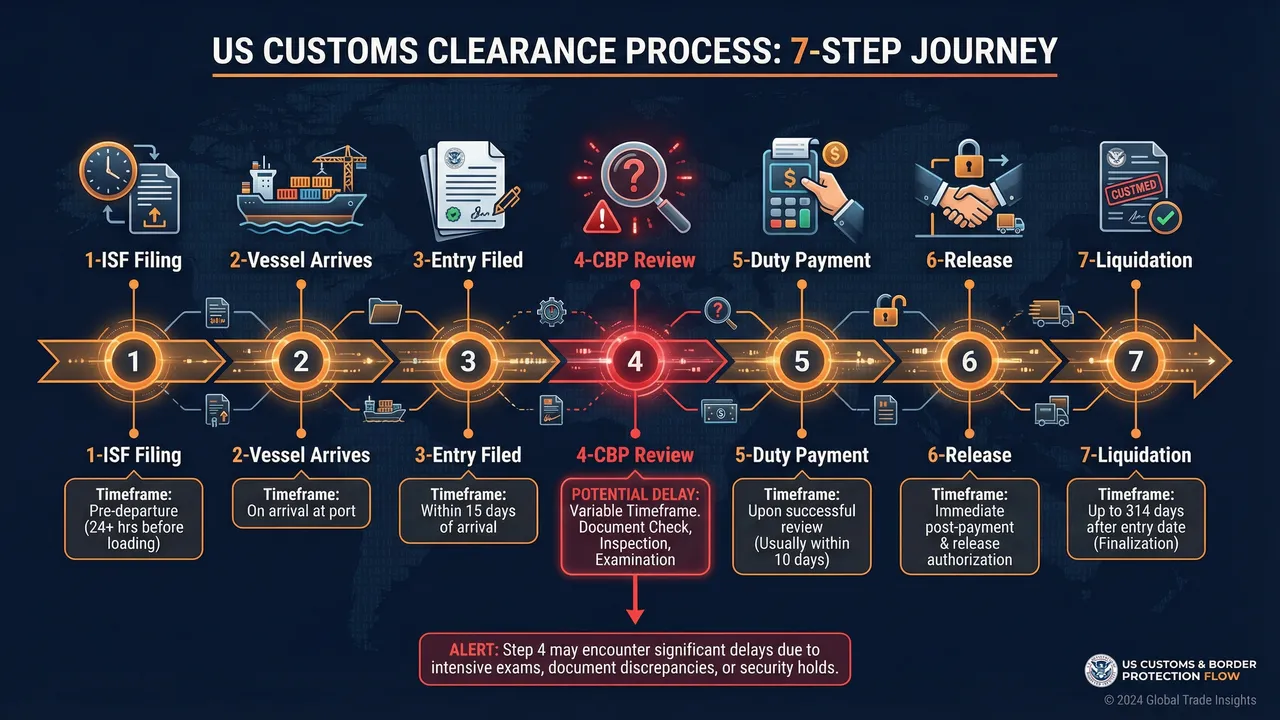
Step 1: ISF Filing (Importer Security Filing)
When: 24 hours before vessel departure from China Who files: Your customs broker or freight forwarder Cost: $25+ per filing What's included: 10 data elements about the shipment (manufacturer name, seller, buyer, HS code, container stuffing location, etc.)
Critical: Late or missing ISF = $5,000 fine per occurrence. This is the most commonly missed step for new importers.
Step 2: Vessel Arrives at US Port
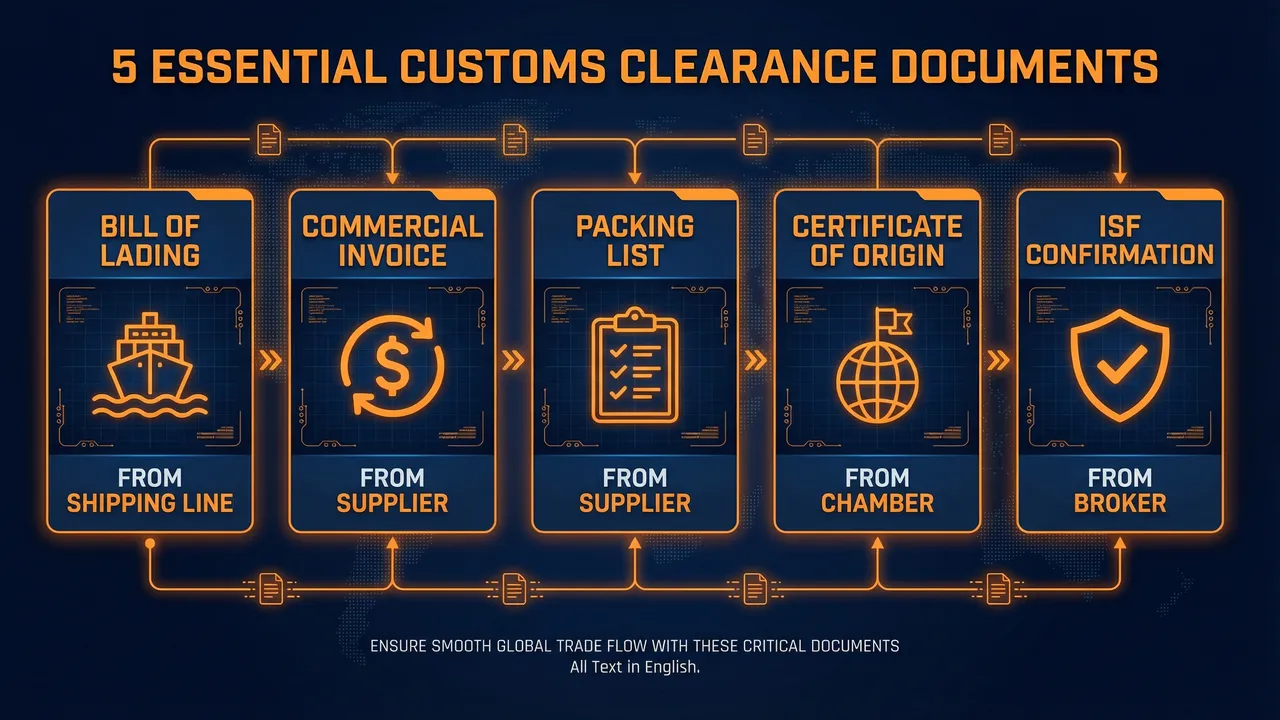
Your freight forwarder tracks the vessel and coordinates with the port terminal. Documents needed upon arrival:
| Document | Who Provides | Purpose |
|---|---|---|
| Bill of Lading (B/L) | Shipping line via freight forwarder | Proof of shipment, title document |
| Commercial Invoice | Your supplier | Declares value of goods |
| Packing List | Your supplier | Details contents per carton |
| Certificate of Origin | Supplier or chamber of commerce | Proves country of manufacture |
| ISF confirmation | Your broker | Proves ISF was filed |
Step 3: Customs Entry Filed
Your customs broker submits a formal entry to CBP within 15 calendar days of arrival. Two main types:
| Entry Type | When Used | Value Threshold |
|---|---|---|
| Informal (Type 01) | Shipments under $2,500 | No bond required |
| Formal (Type 11) | Shipments >$2,500 | Bond required |
Step 4: CBP Review
CBP reviews your entry. Three possible outcomes:
- Cleared (80+% of entries) - goods released within 1-3 days
- Document review (5+%) - CBP requests additional info, 3-5 days
- Physical examination (2-5%) - CBP opens and inspects the container, 5+ days
Step 5: Duty Payment
Pay duties within 10 working days of cargo release. Duty amount = declared value x applicable duty rate.
Step 6: Release
Goods are released from the port terminal. Your drayage company (or freight forwarder) picks up the container and delivers to your warehouse.
Step 7: Final Liquidation
CBP has up to 314 days (10 months + 4 days) from the date of entry to finalize the duty assessment. If they determine you underpaid, you'll receive a bill. If you overpaid, you'll receive a refund.
The Customs Bond
Required for all formal entries (shipments >$2,500):
| Bond Type | Cost | Validity |
|---|---|---|
| Single entry bond | $50+ per shipment | One shipment only |
| Continuous bond | $300+/year | Unlimited entries for 12 months |
If you import more than 3 times per year, a continuous bond is cheaper.
HS Code: Getting It Right
The Harmonized System (HS) code classifies your product and determines the duty rate. Wrong HS code = wrong duty rate = potential penalties.
How to Find Your HS Code
- USITC HTS Search: hts.usitc.gov - official US Harmonized Tariff Schedule
- Your customs broker: They classify products for a living
- CBP Ruling Search: search.cbp.gov for past classification rulings on similar products
- Your supplier: Chinese suppliers often know the HS code, but verify independently
Common HS Code Mistakes
| Mistake | Consequence |
|---|---|
| Using the 6-digit international code instead of the 10-digit US code | Duty rate may be wrong |
| Classifying a "set" vs individual items incorrectly | Different duty rates apply |
| Ignoring material composition | Plastic vs. silicone vs. rubber have different classifications |
| Using the supplier's suggested HS code without checking | Suppliers sometimes suggest lower-duty codes to make their pricing look better |
For a deeper dive into duty rates, read our Import Duty Explained guide.
When Customs Examinations Happen
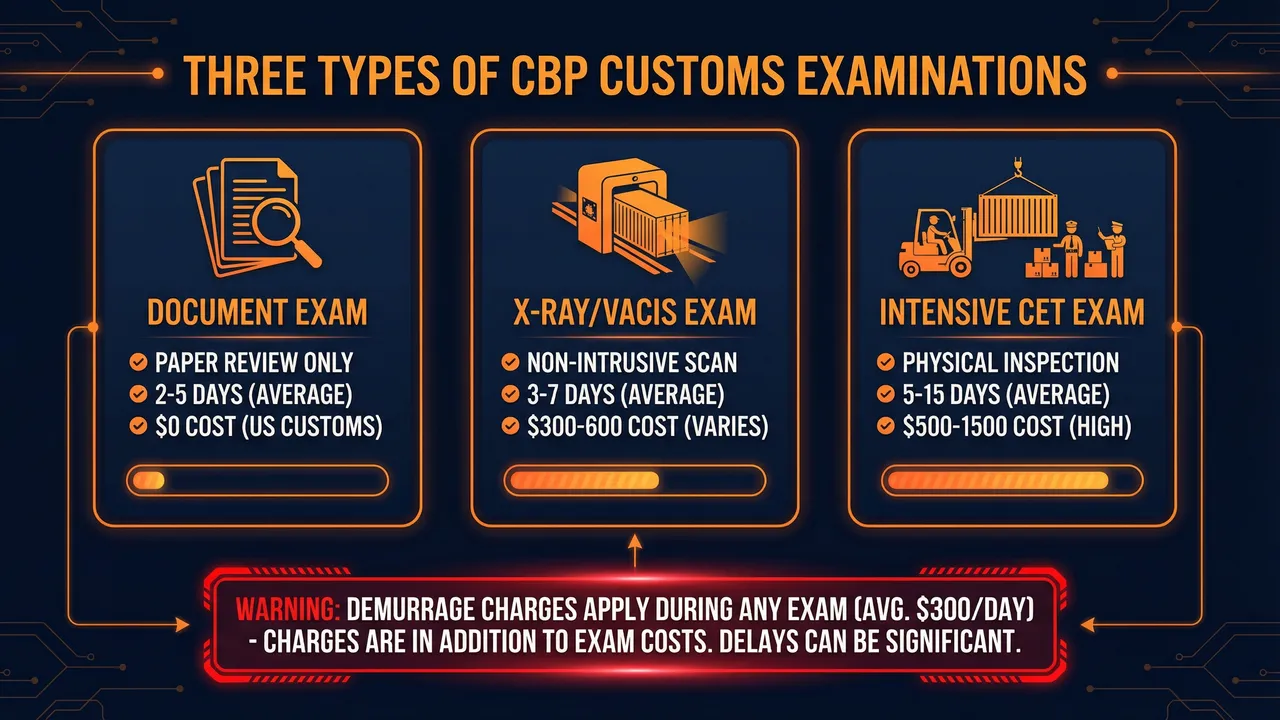
CBP selects shipments for examination based on several factors:
- Random selection - about 2-5% of all entries
- Risk profiling - new importers, high-risk categories (electronics, food, textiles)
- Anomalies - declared value seems too low, weight doesn't match documentation
- Product-specific holds - CPSC (toys), FDA (food), EPA (chemicals)
What Happens During an Exam
| Exam Type | Duration | Cost to You |
|---|---|---|
| Document exam | 2-3 days | $0 (just delays) |
| VACIS/X-ray exam | 3-5 days | $300+ (exam fee + trucking) |
| Intensive (CET) exam | 5+ days | $500+ (unloading + re-packing) |
During an examination, you still pay demurrage ($150+/day at most ports) for every day the container sits beyond the free days. This is why correct documentation matters so much.
Supplymo Insight: The most expensive customs problem we've seen wasn't a big fine - it was a 13-day examination on a first-time importer's container of kitchen gadgets. Demurrage: $300/day x 13 = $3,900. Exam fee: $800. Re-packing: $400. Total unexpected cost: $5,100 - on a $4,000 order. The trigger? The commercial invoice listed "kitchen tools" as the description instead of itemizing each product. CBP flagged it because they couldn't verify the HS codes. A customs broker would have caught this before filing. The $200 broker fee looks cheap now.
Customs Broker: Do You Need One?
Yes, for any formal entry (>$2,500). Here's why:
| Task | DIY | Customs Broker |
|---|---|---|
| ISF filing | You figure out 10 data elements | Broker handles it |
| HS code classification | You guess or research | Broker classifies accurately |
| Entry filing | Self-filing through ACE portal | Broker files electronically |
| Duty calculation | You calculate manually | Broker calculates + pays for you |
| Exam response | You deal with CBP directly | Broker handles all communication |
| Cost | $0 + your time + risk | $150+ per entry |
Common First-Timer Mistakes
- Filing ISF late - $5,000 fine, and it's enforced
- Not having a customs bond - shipment sits at port until bond is arranged
- Wrong HS code - overpaying or underpaying duty (both cause problems)
- Inaccurate commercial invoice - CBP flags value discrepancies
- Missing "Made in China" labels - country of origin marking is required on every unit
- Shipping restricted goods without permits - CPSC (children's), FDA (food/cosmetics), FCC (electronics)
- Not budgeting for demurrage - the clock starts ticking the moment free time expires
Worked Example: First US Entry for a 500-Unit Shipment
A first-time importer buys 500 kitchen products at $3.20 each (FOB). The goods arrive in Los Angeles by sea.
| Item | Amount |
|---|---|
| FOB value | $1,600 |
| Domestic CN to port | $50 |
| Dutiable value (FOB basis) | $1,650 |
| Duty (10.9%) | $179.85 |
| Bond + broker + ISF | $260 |
| Exam contingency reserve | $150 |
Total border-side cost is $589.85 before final drayage and warehouse inbound.
In this case, the shipment clears in 3 business days because documentation is clean (commercial invoice, packing list, B/L, HS code consistency). A single mismatch in carton count would likely push clearance to 5+ days and trigger extra storage charges.
Before every shipment, run the HS code and duty math in Import Duty Calculator, then fold those costs into Landed Cost Calculator.
FAQ
Q: How long does customs clearance take?
1-3 business days if all documentation is correct and there's no examination. With a document review, 3-5 days. Physical examination: 5+ days.
Q: Do I need a customs broker?
For shipments under $2,500: optional (informal entry is simpler). For shipments over $2,500: strongly recommended. The $150+ fee is negligible compared to potential fines and delays.
Q: What happens if I use the wrong HS code?
If you overpay: you can request a refund through a protest filing. If you underpay: CBP will send a bill, and repeated violations can lead to penalties (up to 4x the underpaid duty).
Q: Can my freight forwarder handle customs clearance?
Many freight forwarders offer customs brokerage as an add-on service (or partner with a licensed broker). This is usually the most convenient option - one company handles shipping and customs clearance together.
Next Steps
Try: Import Duty Calculator and Landed Cost Calculator.
Need execution support for your first order? Talk to Supplymo.
Don't let customs paperwork delay your shipment or drain your bank account. Get your documentation right the first time.
Find the HS code and duty rate for your product
Need to understand how duties affect your profitability? Read our complete import duty guide or landed cost calculation guide.