Import Duties Explained: What Chinese Goods Actually Cost at the Border in 2026
Ask ten first-time importers what their product will cost to land in the US, and nine will forget duties. The tenth will Google "China import tariff" and see headlines about 145% rates - then panic and abandon the idea entirely.
The truth is somewhere in between. Most consumer product categories from China carry 0+% base duty, with Section 301 tariffs adding 7.5+% on top for many (but not all) categories. Some categories face combined rates above 100%. The difference between profitable and unprofitable can literally come down to one digit in your HS code.
This guide explains how the system works, what you'll actually pay, and how to look up your specific rate - with a worked example that breaks down every dollar.
Key Takeaways
- US import duties on Chinese goods range from 0% to 145% - the rate depends entirely on your product's HS code. According to the USITC Harmonized Tariff Schedule, duty rates vary by 99 chapters.
- The HS code (Harmonized System code) is a 10-digit classification that determines your duty rate - getting it wrong can cost thousands
- Section 301 tariffs add an extra 7.5+% on many Chinese product categories, on top of the base rate
- The US de minimis threshold dropped from $800 to effectively $0 for Chinese shipments in 2026 - even small parcels now incur duty
- Always calculate duties before placing your first production order - not after the goods are on the water. Factor them into your landed cost.
How Import Duties Work
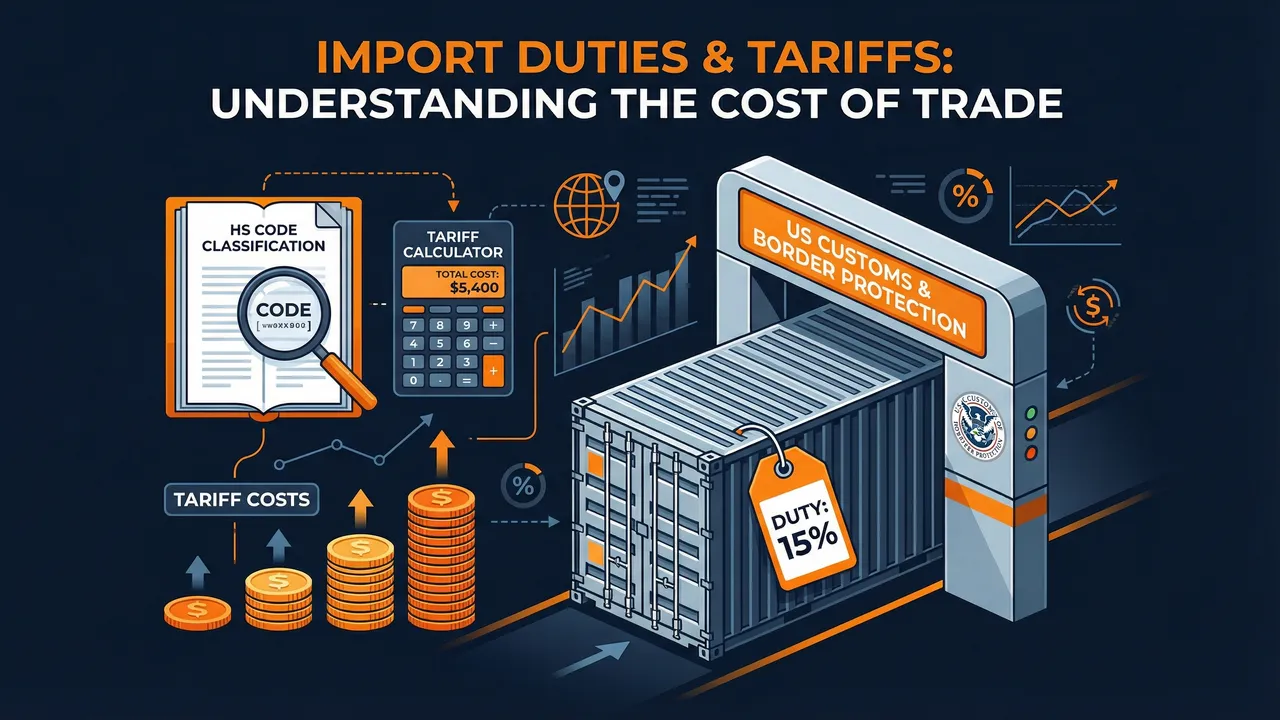
Import duties (also called tariffs or customs duties) are taxes charged by a government on goods entering from a foreign country. They're calculated as a percentage of the goods' declared value. For step-by-step guidance on the clearance process itself, see our customs clearance guide.
Basic formula:
Duty = Declared Value x Duty Rate
But "declared value" and "duty rate" are both more complicated than they sound.
Declared Value: CIF vs FOB
| Valuation Method | What's Included | Used By |
|---|---|---|
| FOB (Free on Board) | Product cost + inland transport to port | United States |
| CIF (Cost, Insurance, Freight) | Product cost + insurance + ocean freight | EU, UK, most other countries |
The US uses FOB value for duty calculation - meaning you only pay duty on the product cost plus transport to the Chinese port, not on ocean freight. This is actually favorable compared to CIF-based countries where you also pay duty on the shipping cost itself. Learn about all shipping Incoterms in our shipping guide.
HS Codes: The Number That Determines Everything
The Harmonized System (HS) is a global product classification system. Every tradeable product in the world has an HS code, and that code determines your duty rate.
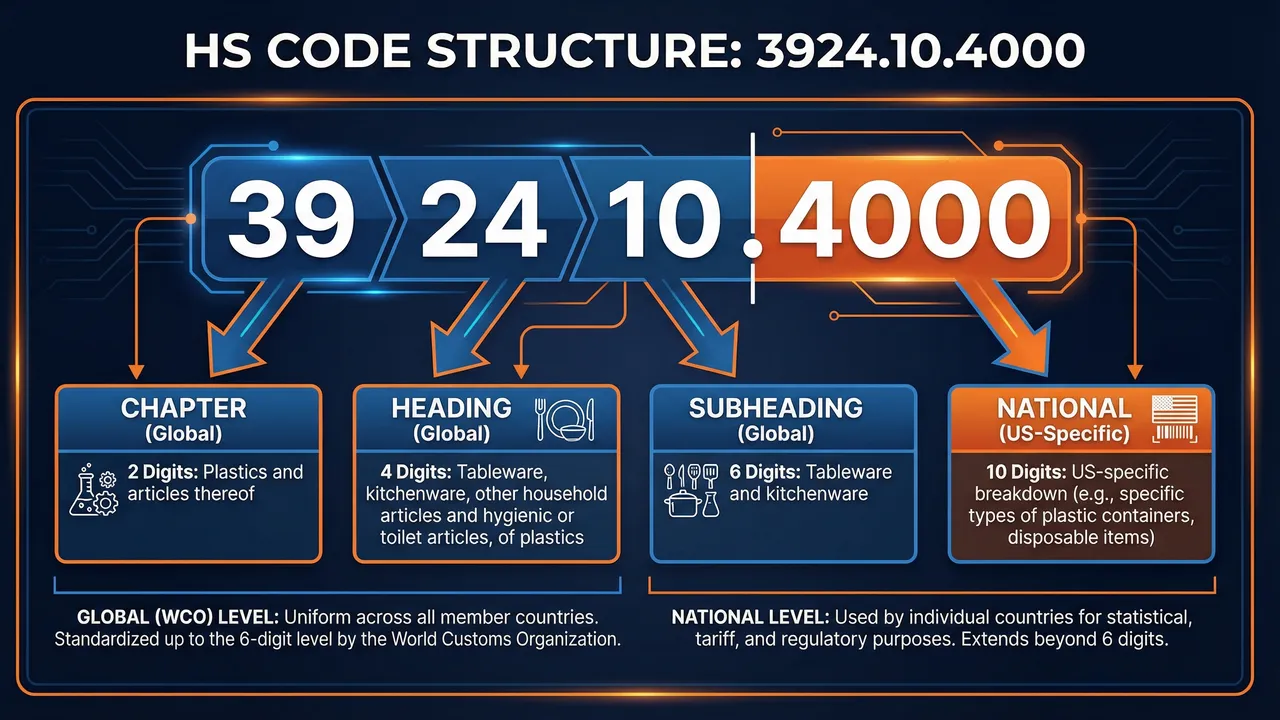
HS Code Structure
| Digits | Level | Example |
|---|---|---|
| First 2 | Chapter (global) | 39 = Plastics |
| First 4 | Heading (global) | 3924 = Household articles of plastics |
| First 6 | Subheading (global) | 3924.10 = Tableware and kitchenware |
| 8+ digits | National (country-specific) | 3924.10.4000 = US-specific rate |
Supplymo Insight: The first 6 digits of an HS code are internationally standardized - they mean the same thing in every country. But digits 7+ are country-specific and that's where duty rates split dramatically. For example, HS 3924.10 (plastic kitchenware) carries 3.4% duty in the US but 6.5% in the EU. Always look up the full 8+ digit code for your destination country. Use our Import Duty Calculator to check rates for US, EU, and UK simultaneously.
How to Look Up Your HS Code
- US: Search the USITC Harmonized Tariff Schedule - the official database
- EU: Use the TARIC database for EU-specific rates
- UK: Check the UK Trade Tariff tool
- Or use our Import Duty Calculator which covers all three markets
Common classification mistakes:
| Mistake | Consequence |
|---|---|
| Using a competitor's HS code without verifying | Their product may differ in material or function |
| Classifying by product name, not composition | A "yoga mat" could be rubber (4016), plastics (3918), or textiles (5703) - each has a different rate |
| Using the wrong country suffixes | A 6-digit code gives you the subheading but not the actual rate |
US Tariff Layers for Chinese Goods (2026)
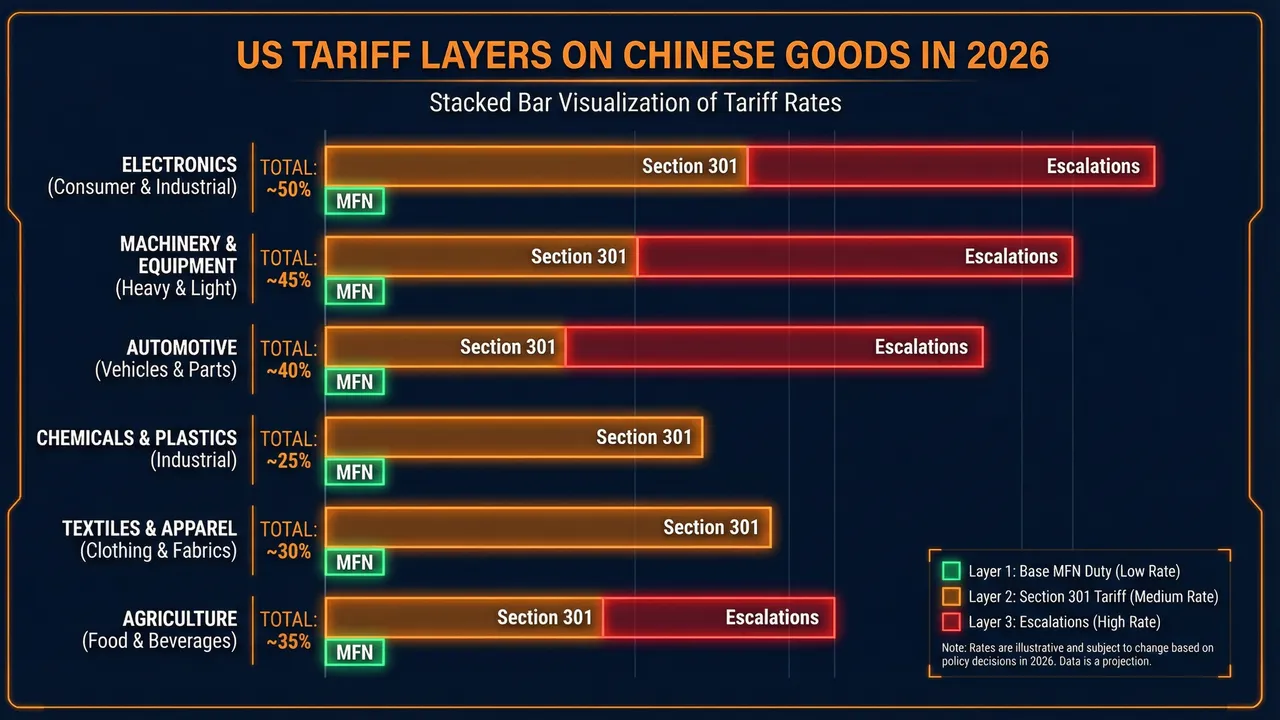
Chinese imports face multiple layers of tariffs. Here's how they stack:
Layer 1: Base MFN Duty
The standard Most Favored Nation (MFN) rate that applies to all countries, based on your HS code.
| Category Example | HS Code | Base MFN Rate |
|---|---|---|
| Silicone kitchen tools | 3924.10 | 3.4% |
| Wooden furniture | 9403.60 | 0% |
| Men's cotton t-shirts | 6109.10 | 16.5% |
| Ceramic mugs | 6912.00 | 0% |
| LED lights | 9405.42 | 3.9% |
| Toys (general) | 9503.00 | 0% |
| Steel screws | 7318.15 | 6.2% |
| Lithium batteries | 8507.60 | 3.4% |
Layer 2: Section 301 Tariffs
Additional tariffs specifically on Chinese-origin goods, enacted under US Trade Law:
| List | Additional Tariff | Products Affected |
|---|---|---|
| List 1 | 25% | Industrial machinery, electronics components |
| List 2 | 25% | Chemicals, plastics, metals |
| List 3 | 25% | Consumer goods, furniture, auto parts |
| List 4A | 7.5% | Apparel, footwear, some electronics |
| List 4B | Previously 15%, now 25% (as of 2025) | Phones, laptops, toys, clothing |
Layer 3: Section 301 Escalations (2025+)
| Product Category | Rate Change | Effective |
|---|---|---|
| EVs, batteries, solar cells | 100% | 2025 |
| Semiconductors | 50% | 2025 |
| Steel and aluminum | 25% additional | 2025 |
| Syringes, PPE | 50% | 2026 |
Supplymo Insight: Most e-commerce sellers overestimate their tariff exposure. In our experience 60% of consumer products fall into the 7.5+% total range (low base rate + List 4A). The scary 100%+ rates apply to specific industrial categories like EVs, solar cells, and semiconductors - not typical Amazon or Shopify products. The key action for every importer: look up your specific HS code before panicking about headlines. We've had clients abandon profitable products because they assumed 100% tariffs applied to everything from China. It doesn't. Check yours with our Import Duty Calculator.
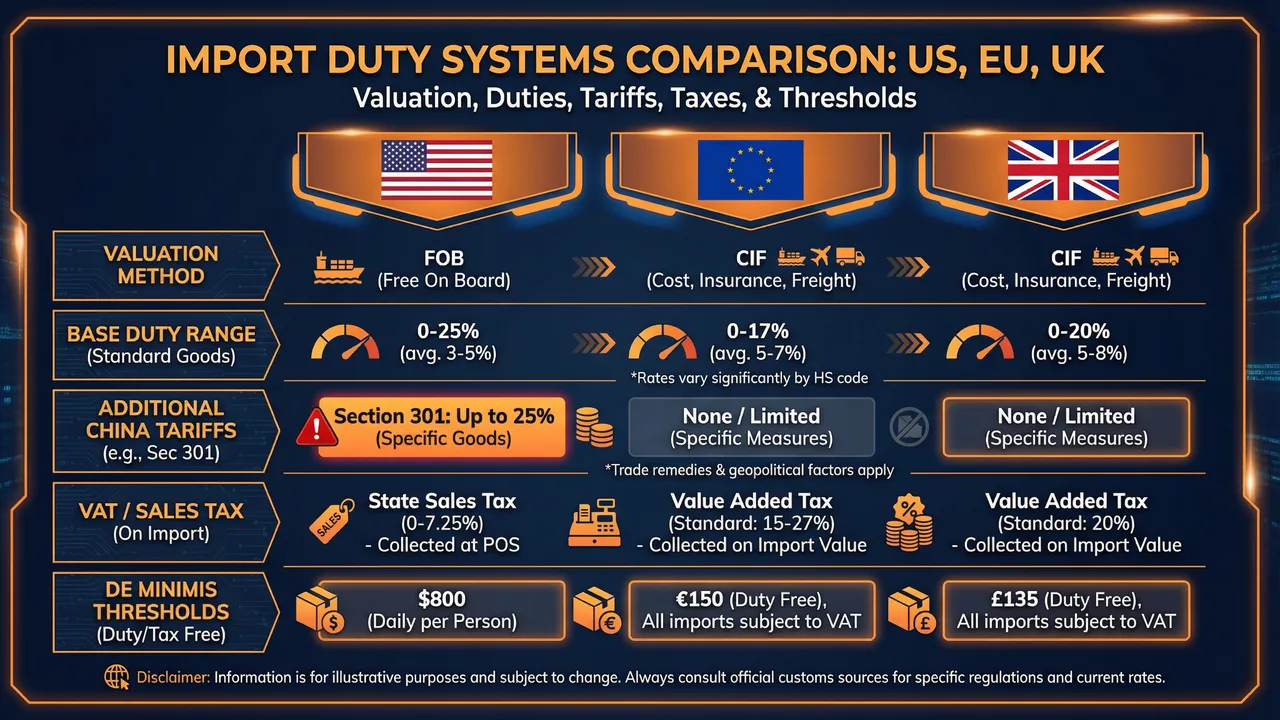
Duty Rates By Market Comparison
| Factor | United States | European Union | United Kingdom |
|---|---|---|---|
| Valuation basis | FOB (product + inland freight) | CIF (product + freight + insurance) | CIF |
| Base duty range | 0+% | 0+% | 0+% |
| Additional China tariffs | Section 301: 7.5+%+ | Anti-dumping (varies) | TRA measures (varies) |
| VAT/Sales tax | None at import (state sales tax separate) | 19+% (EU member state) | 20% |
| De minimis | $0 for China (2026) | EUR 50 | GBP 135 |
| Duty calculator | USITC HTS | TARIC | UK Tariff |
Worked Example: Calculating Total Duty on a Real Product
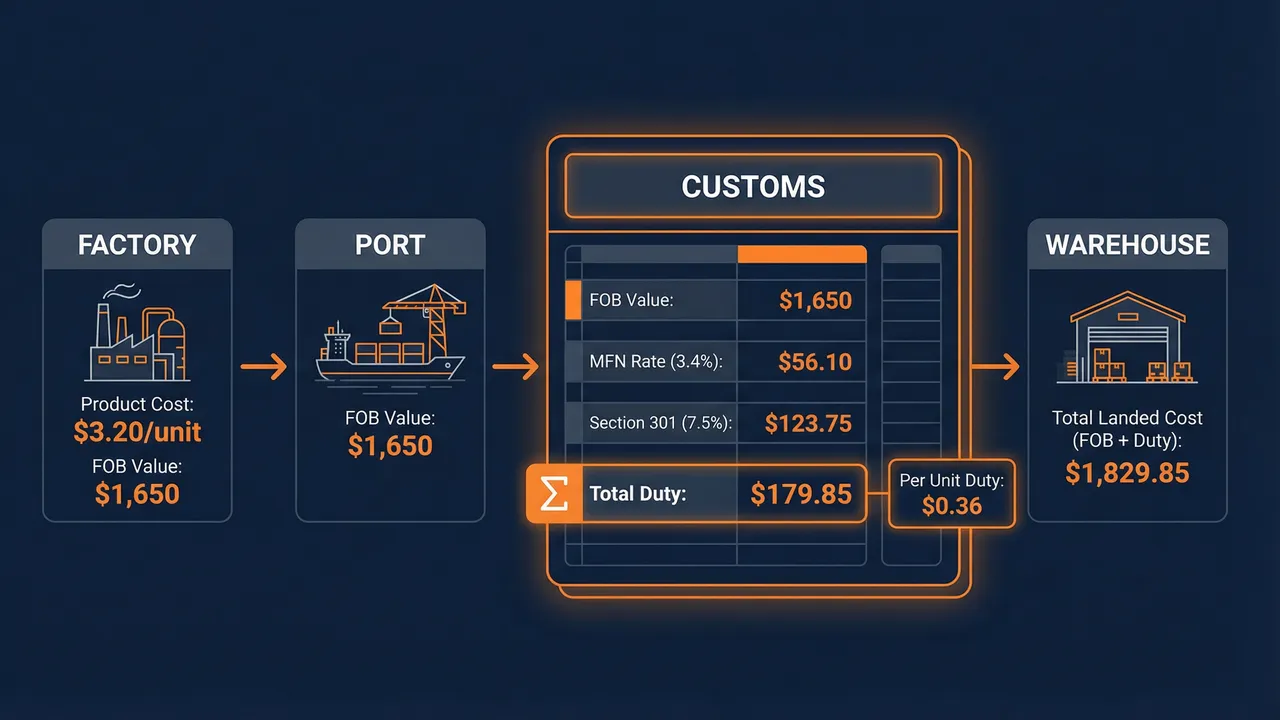
Let's walk through a complete duty calculation for a silicone kitchen utensil set imported from China to the US.
Product: 500 units of silicone spatulas, ordered from a 1688 supplier
| Component | Value |
|---|---|
| Product cost (EXW, factory gate) | $3.20/unit x 500 = $1,600 |
| Domestic transport to port (China) | $50 |
| FOB value (dutiable value) | $1,650 |
Step 1: Identify the HS code
- Product: Silicone kitchen utensils -> HS 3924.10.4000
- Base MFN rate: 3.4%
Step 2: Check Section 301 applicability
- HS 3924 falls under List 4A -> Additional 7.5%
Step 3: Calculate total duty
| Duty Layer | Rate | Amount |
|---|---|---|
| MFN base duty | 3.4% x $1,650 | $56.10 |
| Section 301 (List 4A) | 7.5% x $1,650 | $123.75 |
| Total duty | 10.9% | $179.85 |
| Per unit | $0.36/unit |
At $0.36/unit, duties add about 11% to the product cost - significant enough to factor in, but not a deal-breaker for a product selling at $24.99 with healthy margins.
But change the HS code to a List 3 product (25% Section 301), and the math shifts:
| Scenario | Total Duty Rate | Duty Per Unit | Impact on $24.99 Product |
|---|---|---|---|
| List 4A (7.5% + 3.4% base) | 10.9% | $0.36 | Manageable |
| List 3 (25% + 3.4% base) | 28.4% | $0.91 | Margin pressure |
| List 2 (25% + 6.2% base, steel) | 31.2% | $1.00 | Significant |
| EV batteries (100% + 3.4% base) | 103.4% | $3.31 | Likely not viable |
Tips to Manage Duty Costs
1. Classify Correctly (But Don't Over-Optimize)
The most important step. A wrong HS code can mean:
- Overpaying: Using a higher-rate code that doesn't match your product
- Underpaying + penalties: Using a lower-rate code that doesn't match can trigger a customs audit, fines, and back-duties
If you're unsure, request a Binding Ruling from customs (CBP in the US). It takes 30+ days but gives you a legally binding classification.
2. Declare Accurately
Under-declaring (reporting a lower value than you paid) is customs fraud. It carries penalties of up to 4x the unpaid duty plus potential criminal charges. Not worth the risk for a few hundred dollars in savings.
3. Check Free Trade Agreements (FTAs)
If your product passes through or is substantially transformed in a country with a US FTA, it may qualify for reduced or zero duty. Common route: Chinese components assembled in Vietnam (CPTPP member) may qualify for lower rates.
4. Consider a Foreign Trade Zone (FTZ)
FTZs allow you to import goods, store them, and even process them before formally entering them into US commerce. Duties are deferred until the goods leave the FTZ.
Supplymo Insight: One often overlooked strategy: first sale valuation. If you buy through a sourcing agent or trading company, US customs may allow you to pay duty on the agent's purchase price from the factory (the "first sale") rather than on the higher price you pay the agent. Requirements are strict - you need clear documentation of both transactions - but for orders above $10,000, it can save 3-5% on duties. Consult a customs broker to see if your supply chain qualifies
FAQ
Q: What happens if I use the wrong HS code?
If you underpay duties due to a wrong classification, customs can audit your shipments retroactively (up to 5 years in the US) and charge you the difference plus penalties. If you overpay, you can file for a refund within 180 days of the entry date. Either way, get it right from the start or request a Binding Ruling.
Q: Do I need to pay duties on samples?
In the US, if the total value of your samples is under the de minimis threshold ($800 for most countries, but effectively $0 for China as of 2026), you may still owe duty. However, samples clearly marked as such and of negligible commercial value may be admitted duty-free under specific tariff provisions. Check with your customs broker.
Q: Can I avoid Section 301 tariffs by shipping through another country?
No. Section 301 tariffs apply based on the country of origin (where the product was manufactured), not the country it ships from. Routing Chinese goods through Vietnam or Thailand doesn't change the origin. The only legitimate way to avoid China-origin tariffs is to source from or have the product substantially transformed in a different country.
Q: How do EU VAT and import duty interact?
In the EU, you pay import duty first (on the CIF value), then VAT is calculated on the CIF value plus the duty amount. So VAT compounds on top of duty. For example: EUR 10,000 CIF + 5% duty (EUR 500) = EUR 10,500 x 21% VAT = EUR 2,205 VAT. Total charges: EUR 2,705 on a EUR 10,000 shipment.
Q: Who pays the import duties - the buyer or seller?
It depends on the Incoterm in your purchase agreement. Under FOB or EXW (most common for China imports), the buyer pays all duties. Under DDP (Delivered Duty Paid), the seller pays. Most Chinese suppliers quote FOB or EXW, meaning duties are your responsibility.
Your Next Step
Import duties are a cost, not a mystery. Once you know your HS code and applicable tariff layers, you can calculate duties to the dollar - and factor them into your pricing before the first order.
- Look up your HS code - use the USITC database or our Import Duty Calculator
- Calculate your total landed cost - use our Landed Cost Calculator to see duties in context with all other costs
- Run your profit model - use our Profit Calculator to check if margins hold after duties
- Talk to a customs broker - for orders above $10,000, expert classification advice pays for itself
- Get a sourcing quote - contact Supplymo and we'll help you find products in favorable tariff categories