
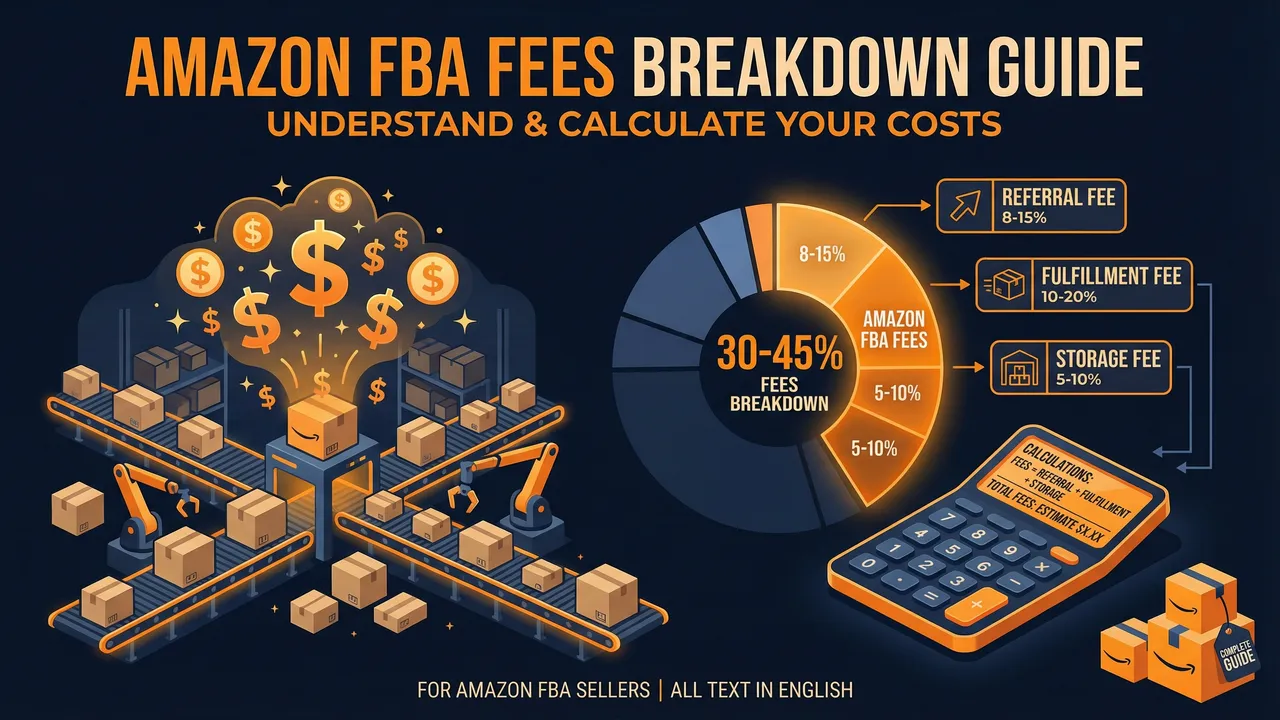
Amazon FBA sellers who don't track every fee are guessing at profitability - and most guess wrong. Amazon takes 30+% of your selling price through a combination of referral fees, fulfillment fees, storage fees, and a growing list of surcharges.
This guide breaks down every FBA fee category with 2026 rates, shows you how to calculate true per-unit profit, and identifies the hidden fees most sellers miss.
Key Takeaways
- Amazon takes 30+% of revenue in combined fees - before your product cost
- Referral fee (8+%) + fulfillment fee ($3.22+) are the two biggest cost components
- Monthly storage fees are low ($0.87/cubic foot standard) but aged inventory surcharges are brutal ($6.90+/cubic foot)
- Product dimensions and weight determine fulfillment tier - a 1-ounce difference can cost $0.50+ per unit
- Use Amazon's Revenue Calculator before sourcing to confirm margins work
FBA Fee Categories (2026)
| Fee Type | Rate | Per Unit (Typical) | When Charged |
|---|---|---|---|
| Referral fee | 8+% of sale price (category-dependent) | $1.50+ | Every sale |
| Fulfillment fee | Size/weight based | $3.22+ | Every sale |
| Monthly storage | $0.87/cu ft (Jan-Sep), $2.40/cu ft (Oct-Dec) | $0.10+ | Monthly |
| Aged inventory surcharge | $0+/cu ft | $0+ | Monthly (over 180 days) |
| Inbound placement | $0.21+/unit | $0.21+ | Per shipment |
| Removal/disposal | $0.97+/unit | If needed | Per request |
| Return processing | Category dependent | $0+ | Per return |
Fee #1: Referral Fee
Amazon charges a percentage of the total sale price (including shipping) as a referral fee for access to their marketplace.
Referral Fees by Category (2026)
| Category | Referral Fee | Min Fee |
|---|---|---|
| Most categories (Home, Kitchen, Sports) | 15% | $0.30 |
| Electronics | 8% | $0.30 |
| Computers | 8% | $0.30 |
| Camera & Photo | 8% | $0.30 |
| Video Games | 15% | N/A |
| Clothing & Accessories | 17% | $0.30 |
| Jewelry | 20% (first $250) | $0.30 |
| Grocery & Gourmet | 8+% | $0.30 |
| Amazon Device Accessories | 45% | $0.30 |
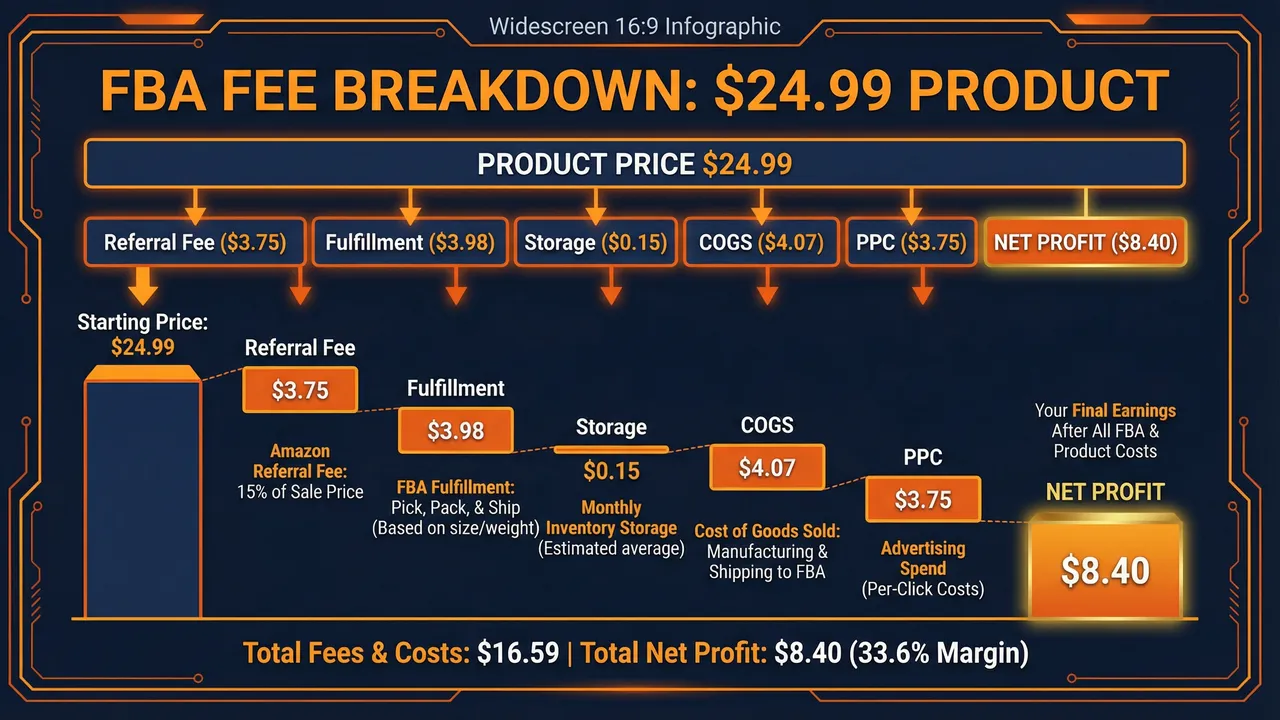
Example: You sell a kitchen gadget for $24.99 to Referral fee: $24.99 x 15% = $3.75
Fee #2: Fulfillment Fee
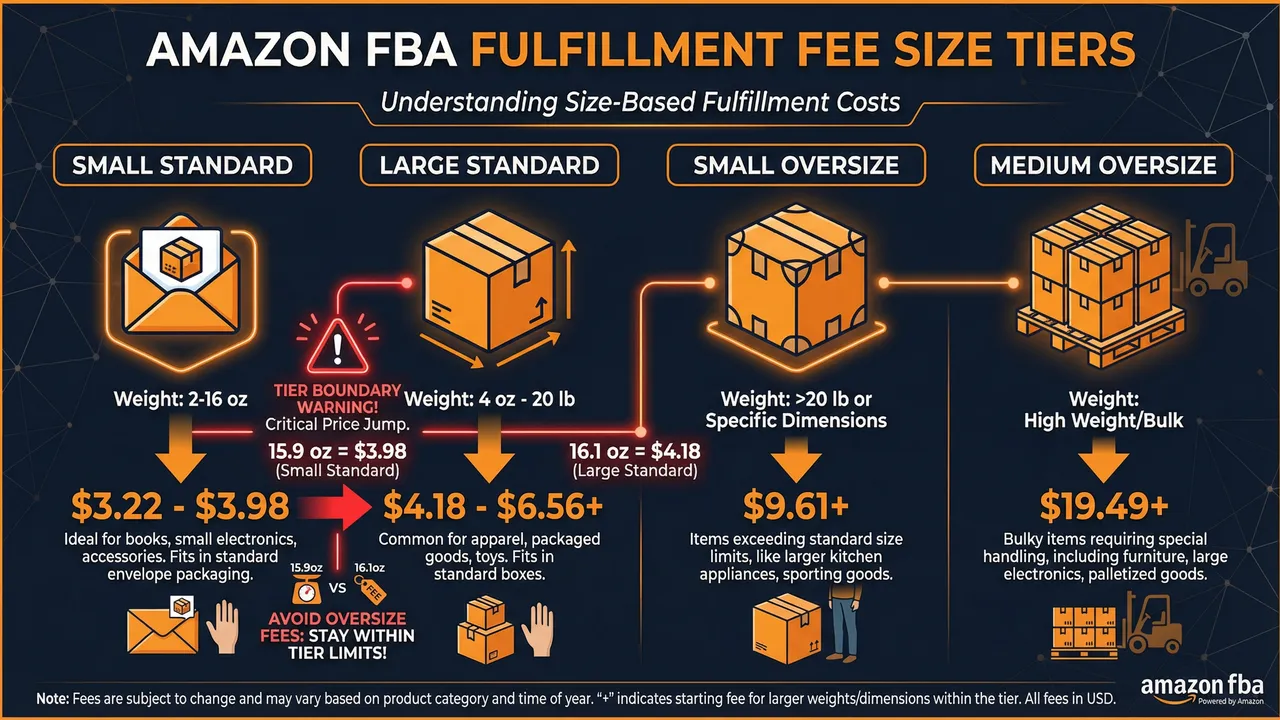
FBA fulfillment fees cover picking, packing, shipping, and customer service. They're based on product size and weight.
Standard-Size Items (2026)
| Size Tier | Shipping Weight | Fee Per Unit |
|---|---|---|
| Small standard | 2-3 oz | $3.22 |
| Small standard | 6+ oz | $3.40 |
| Small standard | 12+ oz | $3.98 |
| Large standard | 13-16 oz | $4.18 |
| Large standard | 17-32 oz | $4.56 |
| Large standard | 1-2 lb | $5.32 |
| Large standard | 2-3 lb | $5.77 |
| Large standard | 3+ lb | $6.56 + $0.42/lb over 3 lb |
Oversize Items
| Size Tier | Fee Per Unit |
|---|---|
| Small oversize (up to 20 lb) | $9.61 + $0.42/lb over 1 lb |
| Medium oversize (20-50 lb) | $19.49 + $0.42/lb over 1 lb |
| Large oversize (50+ lb) | $89.98 + $0.83/lb over 90 lb |
Supplymo Insight: The tier boundary is where you save or lose the most money on FBA fees. A product at 15.9 oz pays $3.98 (small standard). At 16.1 oz, it jumps to $4.18 (large standard) - a $0.20 increase for 0.2 oz. At scale (5,000 units/month), that's $1,000/month lost to 0.2 oz of packaging weight. We tell every client: weigh your product with packaging and optimize to stay in the lowest fee tier. Sometimes removing an inner cardboard insert drops you a tier and saves $0.50/unit.
Fee #3: Storage Fees
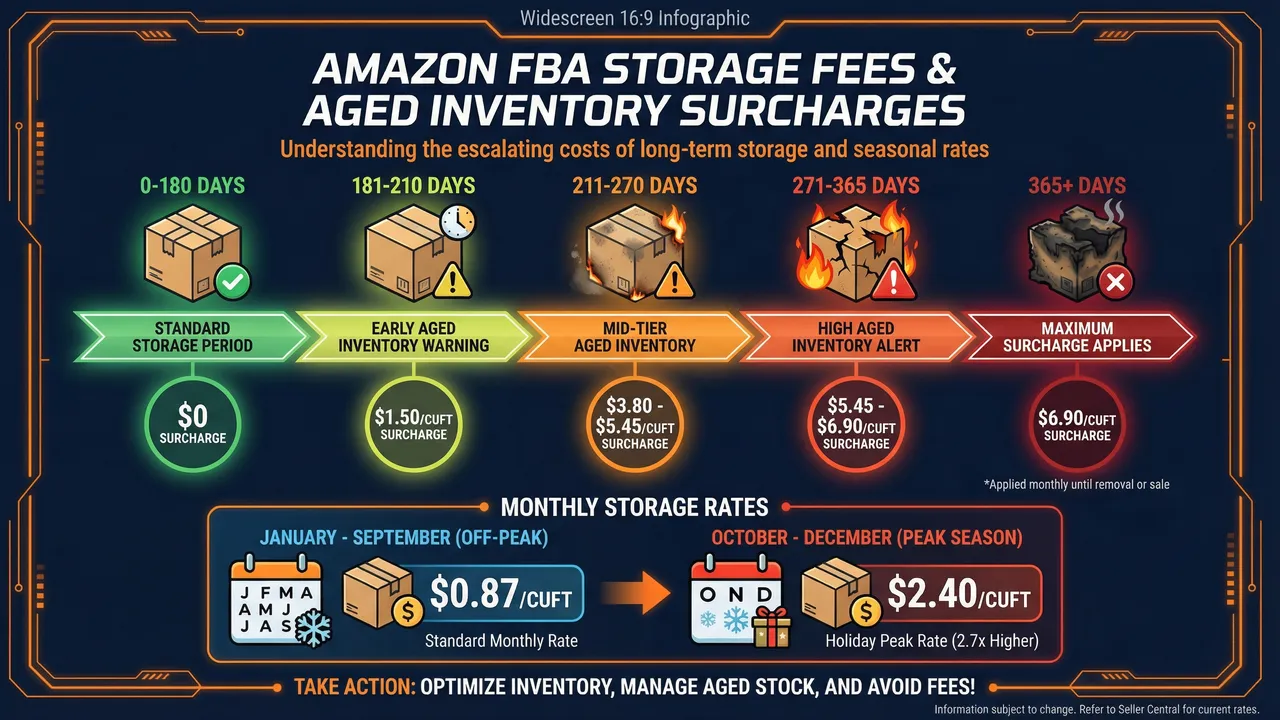
Amazon charges monthly storage fees based on how much space your inventory occupies in their warehouses.
| Period | Standard-Size | Oversize |
|---|---|---|
| January-September | $0.87/cu ft | $0.56/cu ft |
| October-December (peak) | $2.40/cu ft | $1.40/cu ft |
Aged Inventory Surcharge
Inventory sitting over 180 days gets hit with escalating surcharges:
| Age | Surcharge per Cubic Foot |
|---|---|
| 0-180 days | $0 |
| 181+ days | $1.50 |
| 211+ days | $3.80 |
| 241+ days | $5.45 |
| 271+ days | $5.45 |
| 301+ days | $5.45 |
| 331+ days | $6.90 |
| 365+ days | $6.90 or $0.15/unit, whichever is greater |
The lesson: Never ship more than 60 days of inventory to FBA. Slow-moving products become actively expensive after 6 months.
Worked Example: True Per-Unit Profitability
Product: Silicone kitchen spatula set Selling price: $24.99 Weight: 12 oz (with packaging) Dimensions: 14" x 5" x 2" (standard-size) Monthly sales: 500 units
| Line Item | Cost | Per Unit |
|---|---|---|
| Revenue | N/A | $24.99 |
| Referral fee (15%) | N/A | ~3.75 |
| FBA fulfillment fee | N/A | ~3.98 |
| Monthly storage (avg) | N/A | ~0.15 |
| Inbound placement | N/A | ~0.27 |
| Amazon fees total | N/A | ~8.15 (32.6%) |
| Product cost (FOB) | N/A | ~2.50 |
| Shipping from China | N/A | ~0.80 |
| Import duty | N/A | ~0.27 |
| QC inspection | N/A | ~0.15 |
| Packaging (custom box + insert) | N/A | ~0.35 |
| Total COGS | N/A | ~4.07 |
| PPC advertising (15% ACoS) | N/A | ~3.75 |
| Returns (5% rate) | N/A | ~0.62 |
| Total costs | N/A | ~16.59 |
| Net profit | N/A | $8.40 (33.6%) |
This is a healthy margin. But notice: Amazon fees ($8.15) are almost 2x your product cost ($4.07). This is why sourcing cheaper products from China is so critical - the savings go directly to your margin.
Run one more stress test before committing to production: packaging dimensions. If your carton height increases by just a couple of centimeters, Amazon can move your SKU to a higher fee tier and add $0.80-$1.20 per unit. At 500 units per month, that one spec miss can remove $400-$600 from monthly profit. Always confirm final retail packaging dimensions with your supplier and re-check profitability with your real size tier before placing the second order.
Strategies to Reduce FBA Fees
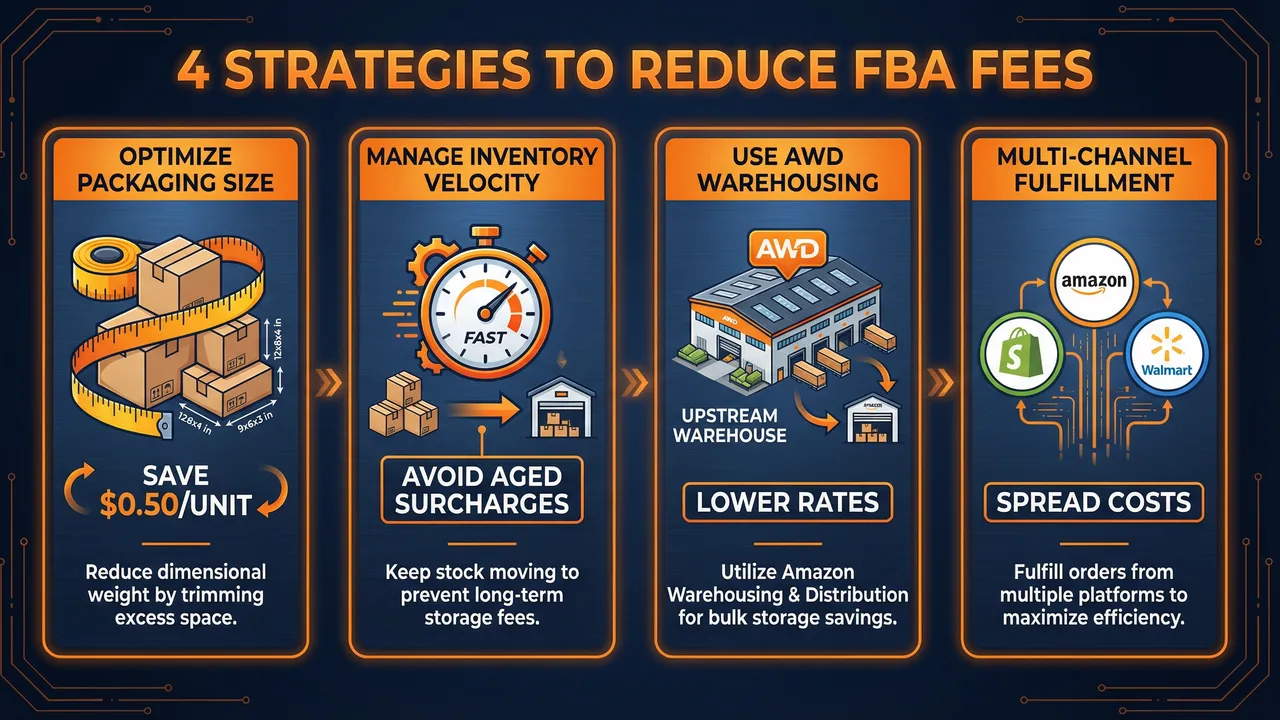
1. Optimize Product Size and Weight
- Reduce packaging dimensions to stay in a lower size tier
- Use lighter packaging materials (corrugated vs solid cardboard)
- Consolidate accessories into smaller form factors
2. Manage Inventory Velocity
- Never ship more than 60 days of inventory to FBA
- Use FBA restock limits to plan shipments
- Create removal orders for slow-selling SKUs before 180-day mark
3. Use Amazon Warehousing Distribution (AWD)
- Pre-position inventory in Amazon's upstream warehouses at lower rates
- Auto-replenish to FBA centers - eliminates inbound placement fees
4. Leverage Multi-Channel Fulfillment (MCF)
- Use FBA to fulfill orders from your own website, Walmart, eBay
- Spreads fixed storage costs across more sales channels
FAQ
Q: What percentage does Amazon take from FBA sellers?
Combined referral fee + fulfillment fee + storage typically equals 30+% of the selling price, depending on category, product size, and advertising costs.
Q: How do I calculate my FBA fees before sourcing?
Use Amazon's Revenue Calculator - enter a competitor's ASIN, your expected selling price, and product cost. It shows all applicable fees.
Q: What's the minimum profit margin for FBA?
Aim for 25+% net profit margin after ALL costs (Amazon fees, COGS, PPC, returns). Below 20%, you have very little buffer for fee increases or competitive price pressure.
Q: Are FBA fees going up in 2026?
Amazon adjusts fees annually, typically in January. In 2026, fulfillment fees saw moderate increases (2-5%) while storage fees remained stable. The biggest change: inbound placement fees became mandatory for split shipments.
Next Steps
Try: Profit Calculator and Landed Cost Calculator.
Need execution support for your first order? Talk to Supplymo.
Know your fees before you source. Amazon's fee structure determines your maximum product cost - which determines which products are worth importing.
Estimate your product profitability with the FBA Calculator
Run a full landed cost analysis for your product
Need to reduce your sourcing cost? Read our Amazon FBA Sourcing Guide for strategies to source profitable products from China.