Amazon FBA Sourcing from China: The 2026 Guide That Actually Shows You the Numbers
Most FBA sourcing guides read like a Wikipedia article - they tell you what sourcing is, but never what it costs. You finish reading and still can't answer the one question that matters: will I actually make money on this product?
This guide is different. Every claim has a number behind it. Every number has a source. And at the end, you'll walk through a full cost breakdown for a real product - from factory floor in Ningbo to Amazon's warehouse in Los Angeles.
Key Takeaways
- 1688.com prices run 10+% below Alibaba for the same products - but you'll need a sourcing agent or Supplymo to navigate it
- Ocean freight from China to the US West Coast sits at roughly $1,900/container (FEU) in early 2026 - down significantly from the $5,000+ spikes of 2024
- Amazon stopped offering FBA prep services in January 2026 - your goods must arrive fully labeled and polybagged
- US tariffs on Chinese imports range from 7.5% to 145% depending on category - always check your HS code before committing
- The standard payment split with Chinese suppliers is 30% deposit, 70% before shipment - never pay 100% upfront
The FBA Sourcing Process at a Glance
Here's the full journey from idea to inventory:
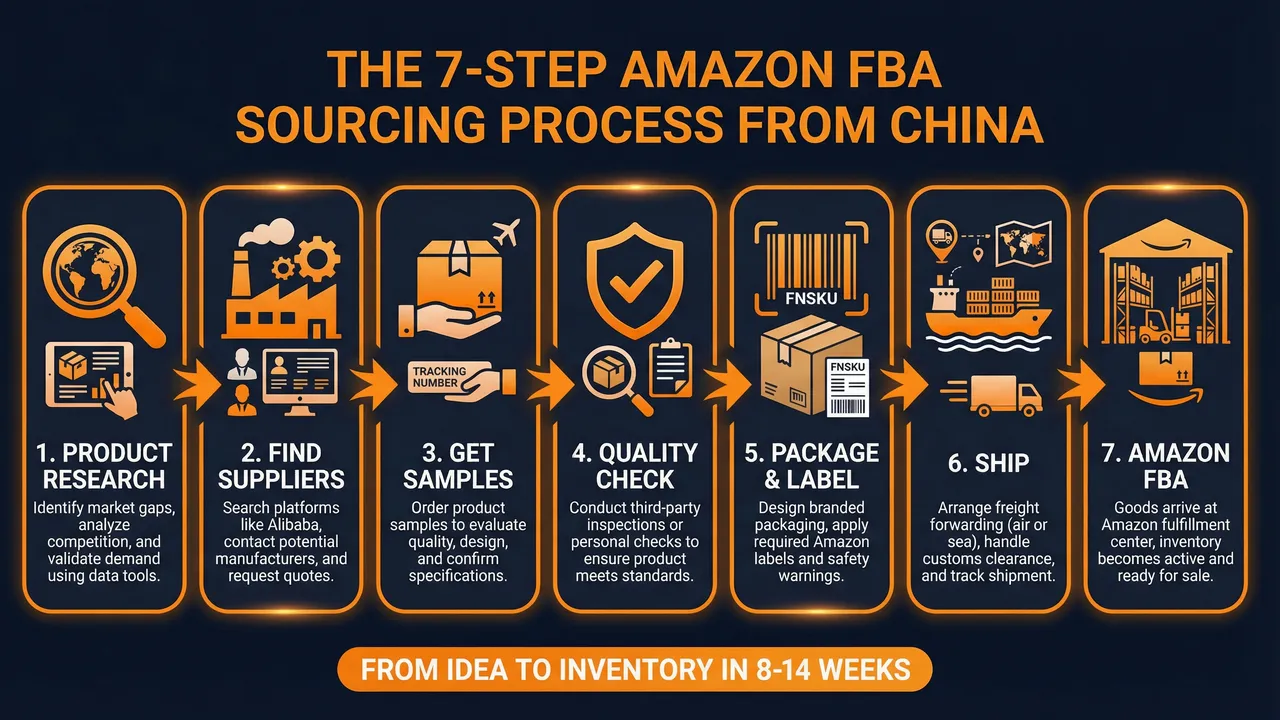
Total time from first search to first sale: 8+ weeks (sea freight) or 6+ weeks (air freight).
Why China Still Dominates FBA Sourcing (Yes, Even with 145% Tariffs)
US tariffs on Chinese goods have climbed to eye-watering levels. Some categories face combined rates of 125+%. So why are most FBA sellers still sourcing from China?
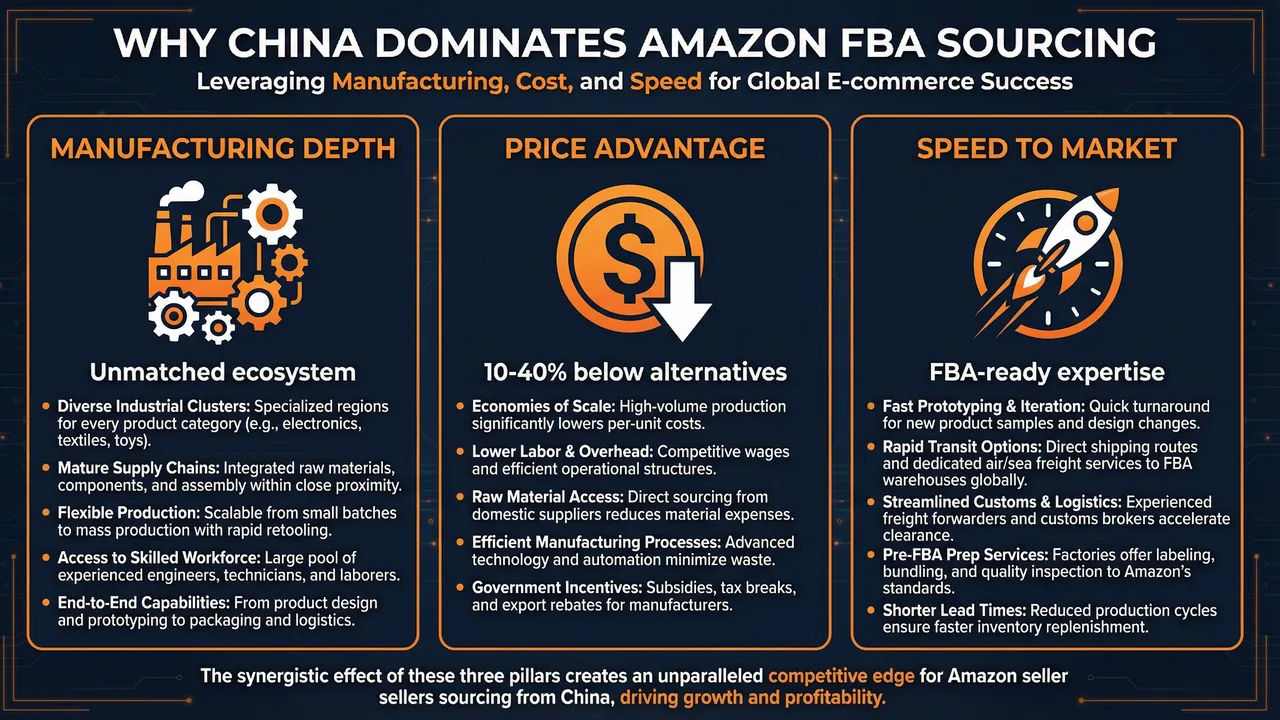
Three reasons:
Manufacturing depth. China's factory ecosystem is unmatched. Need a silicone kitchen utensil set with custom Pantone colors, FDA-grade materials, and retail-ready packaging - all from one supplier? That's a Tuesday in Yiwu. Try getting the same from a Vietnamese factory with no existing tooling, and you're looking at 6+ months of development before your first sample ships.
Price absorption. Even with tariffs, many categories remain profitable. A product that costs $2.50 on 1688 might cost $4.00 from a comparable Indian or Mexican supplier - and the tariff gap doesn't always close that difference.
Speed to market. Chinese suppliers have decades of experience fulfilling Amazon-specific requirements. They know what FNSKU labels look like. They know Amazon's carton weight limits. That institutional knowledge saves weeks of back-and-forth.
Supplymo Insight: Tariffs don't apply uniformly. Toys (HS 9503) carry 0% base duty, while certain steel products hit 25%+ before Section 301 tariffs even kick in. Before you source anything, look up your product's HS code on the USITC Harmonized Tariff Schedule. A 5-minute search can save you thousands. We've seen sellers abandon profitable products because they assumed "everything from China has 100% tariff" - it doesn't.
When China Doesn't Make Sense
Be honest with yourself. If your product falls in a high-tariff category (certain electronics, steel, aluminum), your margins will get crushed. Consider Mexico for nearshoring (tariff-free under USMCA for qualifying goods) or India for textiles and handmade items.
Product Research: Finding What Actually Sells
Skip the "passion product" advice. FBA product selection is a math problem.
You need a product where:
| Criteria | Target |
|---|---|
| Monthly search volume | 3,000+ (enough demand, not dominated by mega-brands) |
| Average selling price | $18+ (high enough for margin, low enough for impulse buys) |
| Top 10 average reviews | Under 500 (you can still compete) |
| Estimated unit cost (from China) | ~20-30% of selling price |
| Weight | Under 2 lbs (keeps FBA fulfillment fees reasonable) |
Use tools like Jungle Scout, Helium 10, or SmartScout to validate demand. But don't stop at Amazon data - check 1688.com to see if the product actually exists at your target cost.
The real validation step most people skip: Search your product on Amazon, read the 1-star and 2-star reviews of the top 3 competitors. These reviews are a goldmine - they tell you exactly what to fix in your version.
1688 vs Alibaba vs Trade Shows: Where to Find Your Supplier
Here's the honest breakdown:
| 1688.com | Alibaba.com | Trade Shows (Canton Fair) | |
|---|---|---|---|
| Price level | Lowest (domestic wholesale) | 10+% higher (export markup) | Varies (negotiable on-site) |
| Language | Chinese only | English | In-person |
| Payment | Alipay / WeChat Pay | Trade Assurance, T/T, L/C | Flexible |
| MOQ | Often 50+ units | Often 500+ units | Negotiable |
| Best for | Experienced importers, cost optimization | Beginners, English-speaking sellers | Relationship building, complex products |
| Biggest risk | No buyer protection, language barrier | Higher prices, trading companies | Travel cost, time investment |
Our recommendation: Start on Alibaba if this is your first product. Switch to 1688 once you have a sourcing agent or feel comfortable navigating in Chinese. The price difference is real - we've seen identical products listed at CNY 15 on 1688 and $4.50 (CNY 32) on Alibaba. For a detailed breakdown, read our Alibaba vs 1688 comparison.
Supplymo Insight: The "Power Seller" badge on 1688 confuses many first-time buyers. It looks like a quality certification, but it's actually just a paid membership tier - any supplier can get it by paying the annual fee. Don't use it as a trust signal. Instead, check years in business, transaction volume, and repeat buyer rate. A supplier with 5+ years and a 40%+ repeat buyer rate is far more reliable than a "Power Seller" with only 6 months of history.
Using a Sourcing Agent
If 1688 sounds appealing but the language barrier stops you - that's exactly what sourcing agents are for. A good agent charges 3-5% of your order value and handles:
- Supplier communication in Chinese
- Factory verification visits
- Sample coordination
- Quality inspection
- Domestic shipping to the freight forwarder
Supplymo's platform lets you search products across both 1688 and Alibaba, compare pricing side by side, and connect with vetted agents - all without needing to read Chinese.
Vetting Suppliers Without Getting Burned
Here's the 5-step process that separates profitable first orders from expensive mistakes:
1. Contact 10+ suppliers, narrow to 3-5
Cast a wide net. Send the same product spec to at least 10 suppliers. Compare their responses on price, MOQ, lead time, and how quickly they reply. Slow responses now mean slow responses when something goes wrong with your order.
2. Ask for EXW pricing
Always request EXW (Ex Works) pricing first - this is the raw product cost at the factory gate, excluding all shipping. It lets you separate product cost from logistics cost and shop for freight independently.
3. Video call your top 3
This takes 10 minutes and reveals more than any certification badge. Ask them to walk you through the production floor. A real factory will show you machines, worker stations, and raw materials. A trading company will show you a showroom.
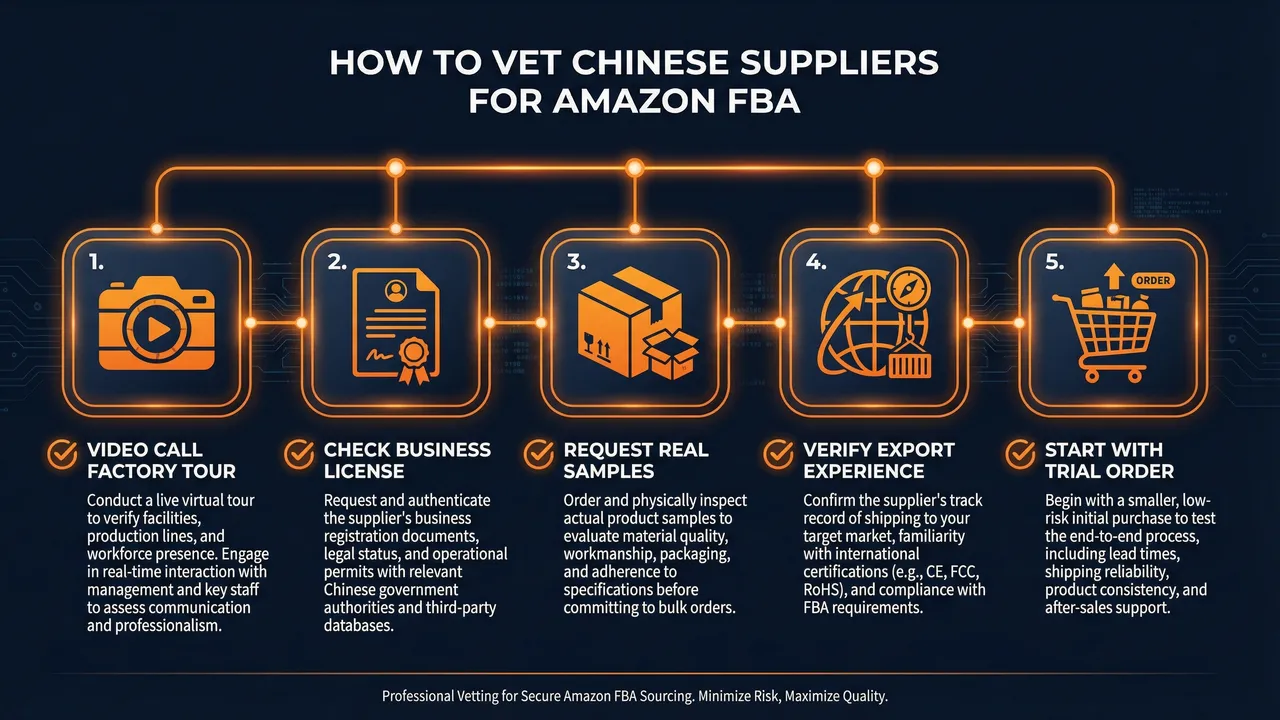
4. Order samples from 2 suppliers
Don't order just one sample. Order from your top 2 and compare. Critical: request production-line samples, not pre-made display samples. Display samples are always perfect - they're made to impress. Production-line samples show what your actual order will look like. Learn more in our product sample request guide.
5. Negotiate payment terms
The standard in China-import trade:
| Milestone | Payment |
|---|---|
| Order confirmation | 30% deposit via T/T (wire transfer) |
| Before shipment (after QC pass) | 70% balance via T/T |
Never pay 100% upfront. If a supplier insists on full payment before production, that's a red flag. On Alibaba, use Trade Assurance for your first order - it adds buyer protection at no extra cost.
FBA-Compliant Packaging and Labeling (2026 Update)
This section matters more than ever. As of January 1, 2026, Amazon stopped providing FBA prep services in the US. That means:
- Amazon will no longer polybag your products
- Amazon will no longer apply FNSKU labels
- Amazon will no longer bundle or bubble-wrap for you
Your products must arrive at the fulfillment center 100% ready to ship to the customer. If they don't, Amazon will reject the shipment or charge penalty fees. Build a solid quality control checklist before your first production run.
What your supplier needs to do (specify this in your PO):
- FNSKU barcode printed and applied on each unit (provide the barcode file)
- Polybag each unit with a suffocation warning if the bag opening exceeds 5 inches
- Master carton labels with Amazon shipment ID, FNSKU, and quantity
- Carton weight under 50 lbs per box (Amazon's limit)
- Carton dimensions that match what you declared in Seller Central
Don't assume your supplier knows Amazon's requirements. Print a one-page spec sheet with photos and send it before production starts. Better yet, use our QC Checklist Generator to create a bilingual checklist your factory can follow.
Shipping to Amazon's Warehouse: Sea vs Air with Real Numbers
Here's what you'll actually pay to ship from China to an Amazon FBA warehouse in the US (Q1 2026 data):
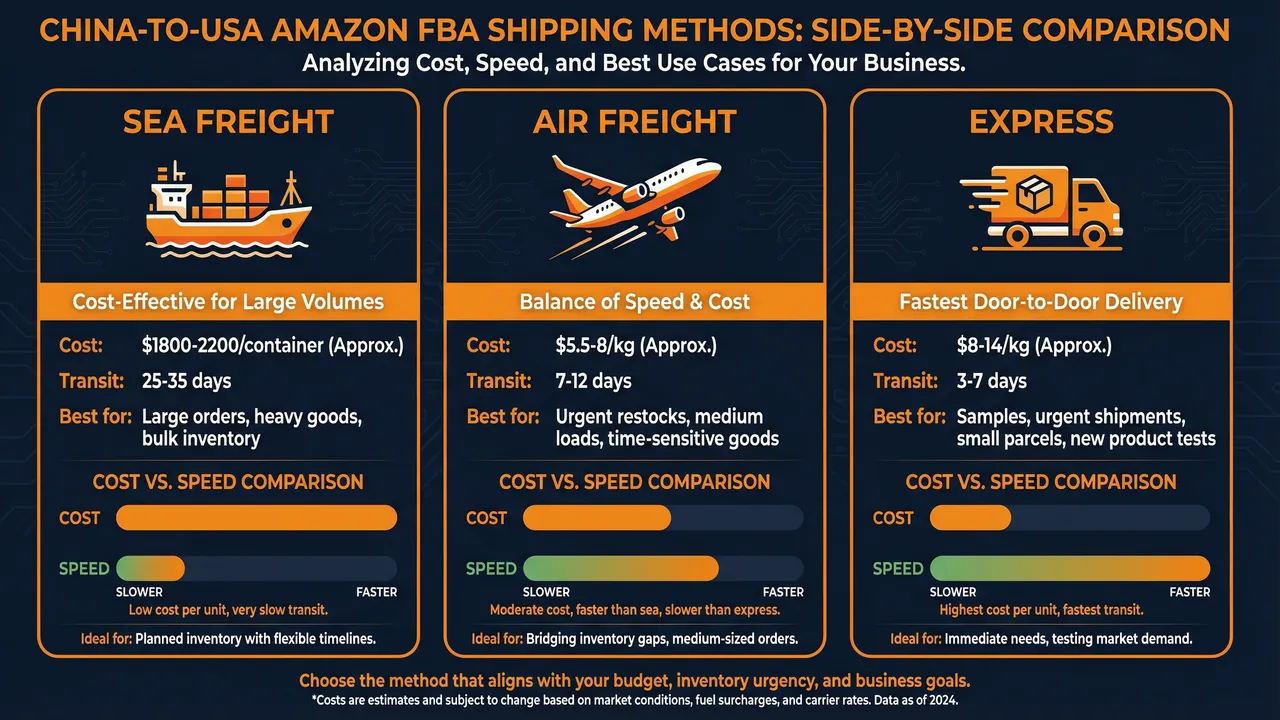
| Method | Cost | Transit Time | Best For |
|---|---|---|---|
| Sea freight (FCL 20GP) | $1,800+ | 25+ days | Large orders (500+ units, heavy goods) |
| Sea freight (LCL) | $80+/CBM | 30+ days | Smaller volumes (2+ CBM) |
| Air freight | $5.50+/kg | 7+ days | Urgent stock, light products |
| Express (DHL/FedEx) | $8+/kg | 3-5 days | Samples, very small batches (under 50 kg) |
Source: Ocean rates based on the Freightos Baltic Index (FBX01) for China to North America West Coast, January 2026. Air freight rates based on Freightos Air Index, Q4 2025-Q1 2026.
Supplymo Insight: Here's the switching point most sellers get wrong. If your shipment weighs under 300 kg, air freight is usually cheaper than LCL sea freight once you factor in warehouse storage days. Sea freight sounds cheaper per-unit, but you're paying for 30+ extra days of aged inventory fees at Amazon ($0.87+/cubic foot/month). For a first FBA order of 200+ small units, air freight often wins on total landed cost. Use our Shipping Calculator to compare both options with your actual product dimensions.
Don't Forget These Hidden Costs
| Cost | Typical Range |
|---|---|
| Customs broker fee | $150+ per entry |
| Import duty | 0+% of declared value (HS code dependent) |
| ISF filing (ocean only) | $25+ |
| Drayage (port to Amazon) | $300+ |
| Amazon inbound placement fee | $0.27+/unit (varies by split option) |
Worked Example: Calculating True FBA Profit
Let's run the numbers for a real product scenario.
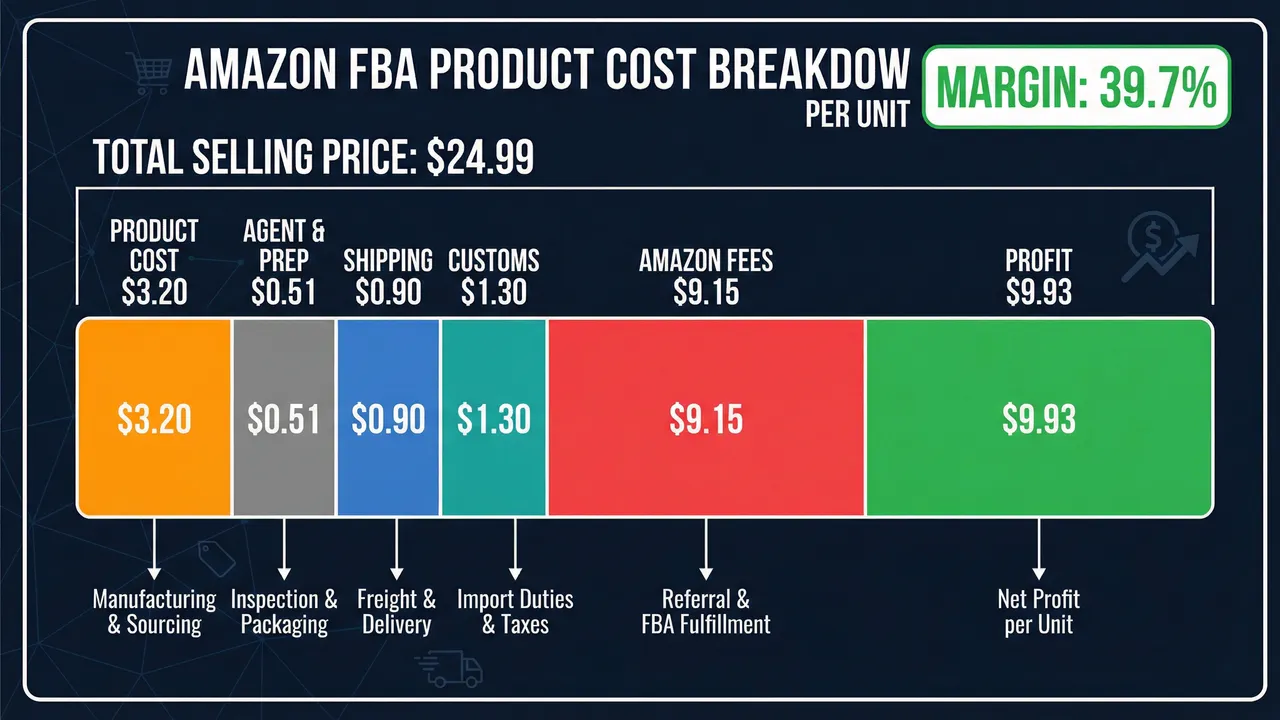
Product: Silicone kitchen utensil set (5-piece), selling on Amazon US at $24.99
| Cost Component | Amount | Notes |
|---|---|---|
| Product cost (1688, EXW) | $3.20/unit | 500 units, CNY 23/unit at 7.2 CNY/USD |
| Sourcing agent fee (5%) | $0.16/unit | |
| FBA packaging & labeling | $0.35/unit | Polybag + FNSKU + carton labels |
| Sea freight (LCL) | $0.90/unit | 2.5 CBM shipment at $95/CBM, 500 units |
| Customs duty (0% - HS 3924) | $0.00 | Silicone kitchen tools, HS 3924.10 |
| Customs broker + ISF | $0.50/unit | $250 total / 500 units |
| Drayage to Amazon FC | $0.80/unit | $400 / 500 units |
| Total landed cost | $5.91/unit | |
| Amazon referral fee (15%) | $3.75 | |
| FBA fulfillment fee | $5.40 | Large standard, 1.5 lbs |
| Total cost per unit | $15.06 | |
| Selling price | $24.99 | |
| Profit per unit | $9.93 | |
| Margin | 39.7% |
That's a healthy margin. But change one variable - say the product falls under a 25% tariff category - and the picture shifts:
| With 25% duty | $0.80/unit duty added; profit drops to $9.13 (36.5%) |
|---|---|
| With 100% duty | $3.20/unit duty added; profit drops to $6.73 (26.9%) |
The lesson: Always calculate profit at your actual duty rate, not a guess. Use our FBA Profit Calculator to model different scenarios with your real product data.
FAQ
Q: Is it still worth sourcing from China for Amazon FBA in 2026?
For most product categories - yes. Despite tariff increases, China's manufacturing cost advantage, production speed, and FBA-specific expertise keep it viable. The key is checking your specific HS code's duty rate before committing. Products with 0+% base duty remain highly profitable. Products facing 100%+ combined tariffs need careful margin analysis.
Q: How much does it cost to source a product from China for FBA?
A typical first order (500 units, standard-sized product) runs $2,500+ all-in - covering product cost, samples, shipping, duties, and Amazon inbound fees. The per-unit product cost from 1688 ranges from $1+ for most consumer goods. Shipping adds $0.50+/unit depending on method and product weight.
Q: Do I need a sourcing agent?
Not strictly, but we recommend one if you're buying from 1688 or don't speak Chinese. A good agent costs 3-5% of order value and handles supplier communication, factory visits, quality inspection, and domestic logistics. The ROI is usually positive - they negotiate better prices than you can get on your own and catch quality issues before shipment.
Q: How long does shipping from China to Amazon take?
Total lead time (production + shipping + Amazon inbound processing):
- Sea freight: 45+ days (15+ production + 25+ transit + 5+ Amazon inbound)
- Air freight: 25+ days (15+ production + 7+ transit + 3-5 Amazon inbound)
- Express: 20+ days (15+ production + 3-5 transit + 2-3 Amazon inbound)
Your Next Step
You now have the numbers. The question isn't "can I source from China?" - it's "which product, which supplier, and what's my real margin?"
Here's how to move forward:
- Research your product - validate demand and competition on Amazon
- Check the tariff rate - look up your HS code to know your real duty
- Find suppliers - search products on Supplymo to compare 1688 and Alibaba pricing
- Run the numbers - use our FBA Profit Calculator to model your full landed cost
- Get a sourcing quote - request a free quote from our vetted sourcing network
The difference between FBA sellers who profit and those who don't isn't luck - it's doing the math before the first wire transfer.