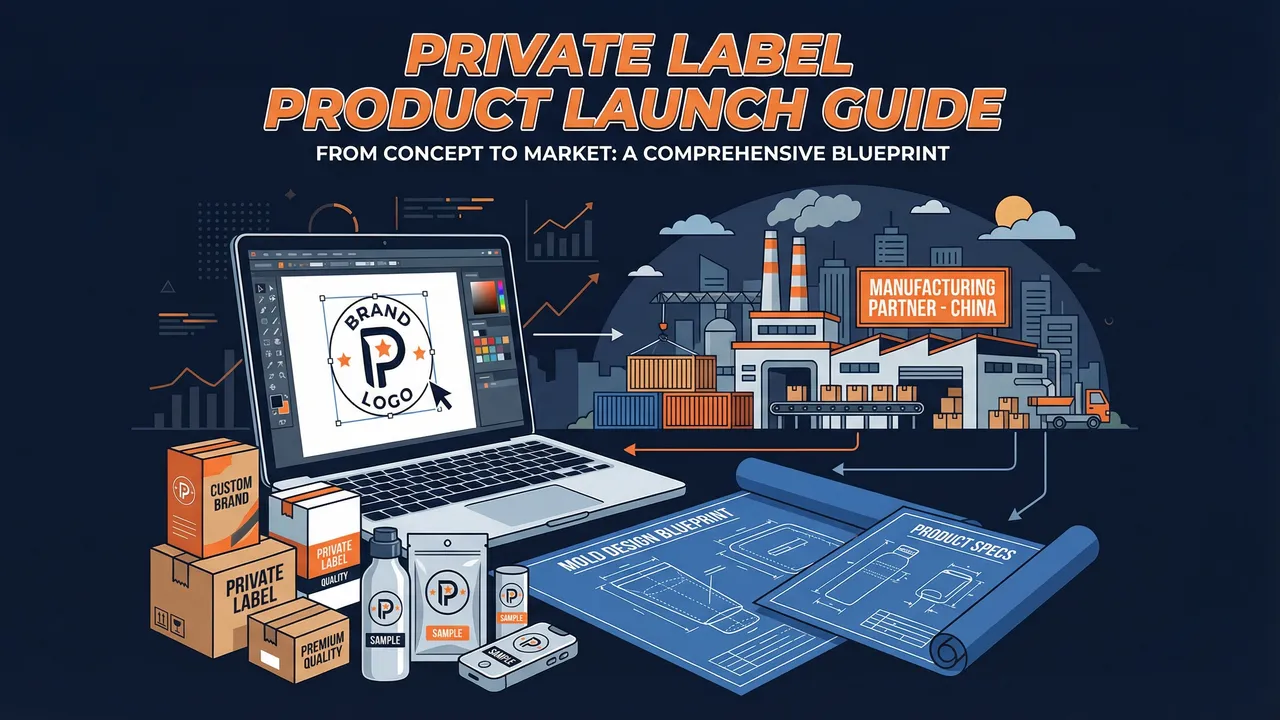
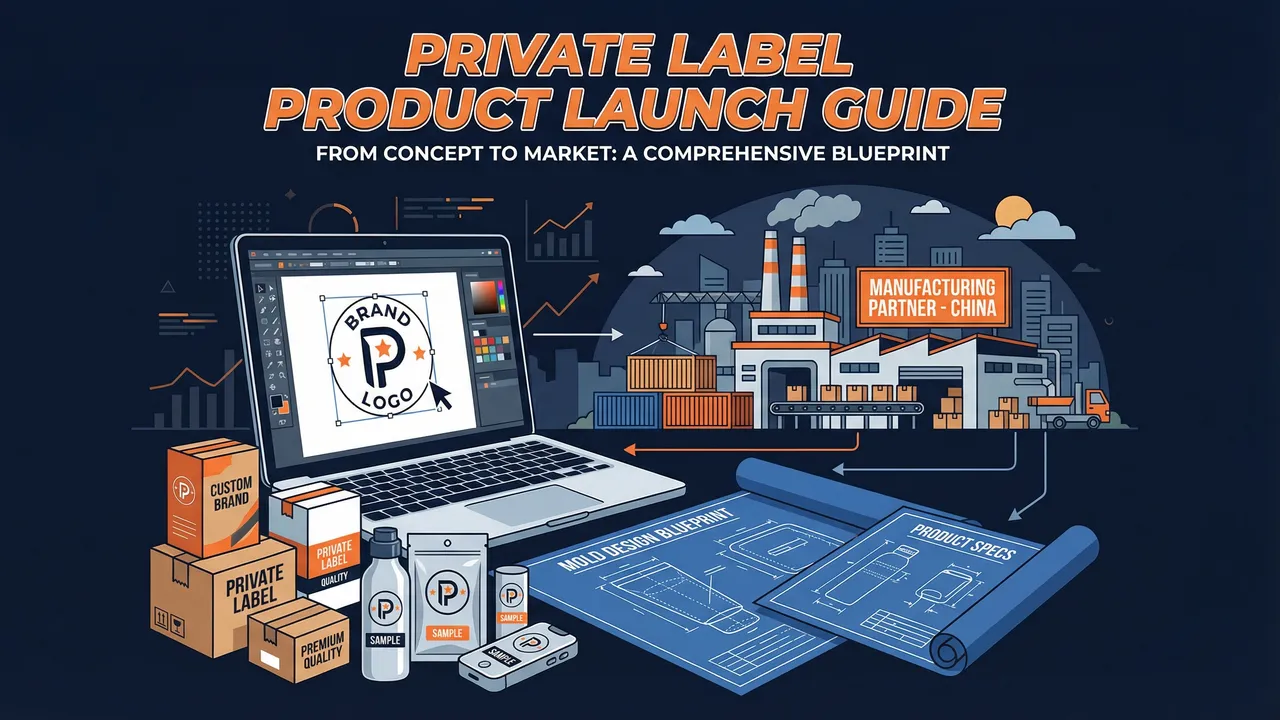
Selling someone else's product under their brand means competing on price alone. Private labeling - putting your brand on a product manufactured in China - gives you pricing power, listing control, and a defensible business. But the process has more moving parts than most guides admit.
This is the step-by-step system we use at Supplymo to help brands launch private label products. No theory - just the 10 steps from concept to first sale, with real costs and timelines. According to Jungle Scout's State of the Seller Report, 59% of Amazon sellers use private-label sourcing from China.
Key Takeaways
- OEM (you design it) costs more upfront but creates unique products; ODM (factory designs it, you brand it) is faster and cheaper
- Realistic budget for a first private label launch: $3,000+ including samples, production, packaging, and shipping
- MOQs for custom products are typically 500+ units - negotiable for simple modifications
- The entire process takes 8+ weeks from supplier contact to inventory in your warehouse
- Packaging and inserts are where private label differentiation actually happens - not the product itself
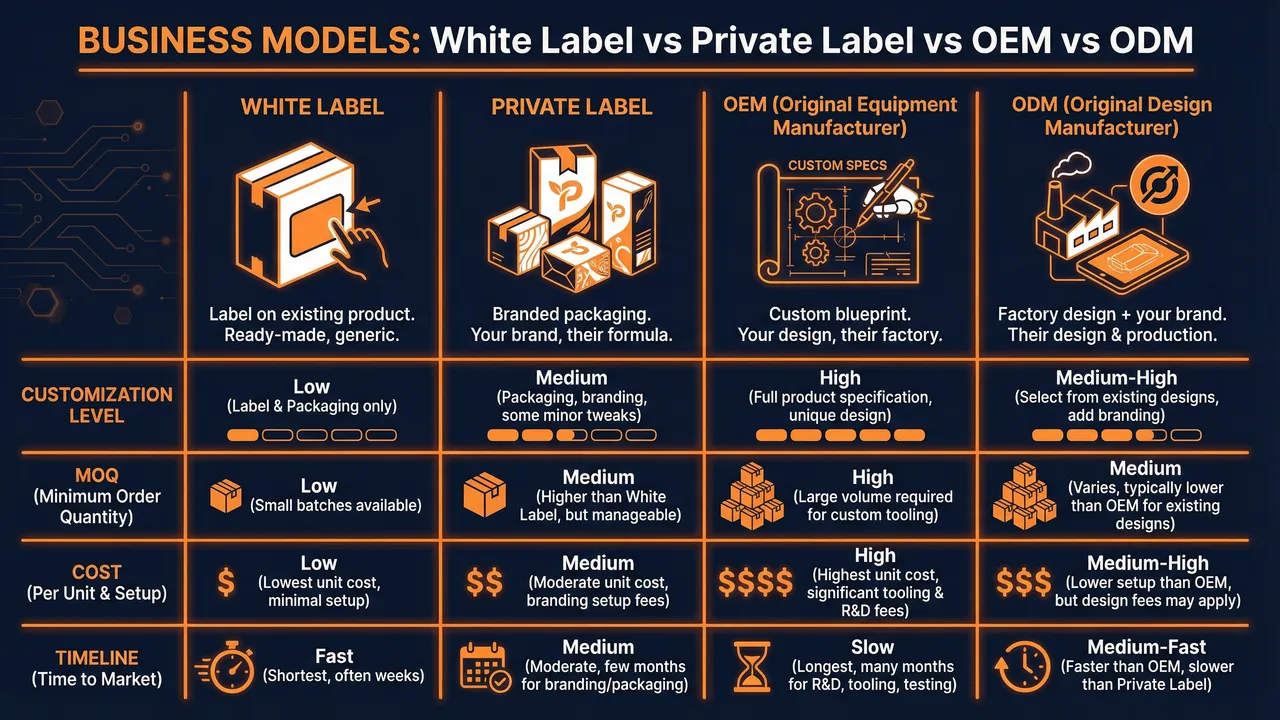
Private Label vs White Label vs OEM vs ODM
Before picking a supplier, understand what you're actually asking for:
| Model | What It Means | Customization | MOQ | Best For |
|---|---|---|---|---|
| White Label | Existing product, your label slapped on | Logo only | 100+ | Testing a market fast |
| Private Label | Existing product, your branding and packaging | Logo + packaging | 500+ | Most Amazon sellers |
| OEM | Custom product to your design specifications | Full custom | 1,000+ | Unique product ideas |
| ODM | Factory's design, your brand and modifications | Design tweaks + branding | 500+ | Leveraging factory R&D |
Supplymo Insight: Most successful Amazon private label sellers start with ODM, not OEM. You take a factory's existing product design, request 2-3 modifications (material upgrade, color change, size adjustment), add your branding and premium packaging, and you've created a differentiated product in half the time and at half the cost of true OEM. The factory already has the mold, the production process is proven, and your modifications give you enough differentiation to avoid direct competition. We've helped launch 50+ products this way with a 70% success rate on first launch.
Step 1: Product Research and Validation
Before contacting any factory, validate that your product idea has demand and margins.
Validation Checklist
- Search volume: Primary keyword gets 3,000+ monthly searches
- Competition: Fewer than 300 reviews on the top 5 listings (room to compete)
- Price point: Target selling price of $15+ (sweet spot for margins)
- Sourcing cost: Can you source at 20+% of retail price? (aim for 4-5x markup)
- Size/weight: Light and small = lower shipping and FBA fees
- No IP/patent issues: Search USPTO, Google Patents, and Amazon Brand Registry
- Not regulated: Avoid FDA, CPSC, and FCC-heavy categories on your first product
Product Research Tools
Use Amazon BSR (Best Seller Rank) to estimate monthly sales. A rough formula:
Monthly units ~BSR-based estimate (varies by category)
Top 10 BSR in Home & Kitchen ~1,000+ units/month
Top 100 BSR ~300+ units/month
Top 1,000 BSR ~50+ units/month
Step 2: Finding OEM/ODM Factories
Where to Search
| Platform | Best For | Language | MOQ Range |
|---|---|---|---|
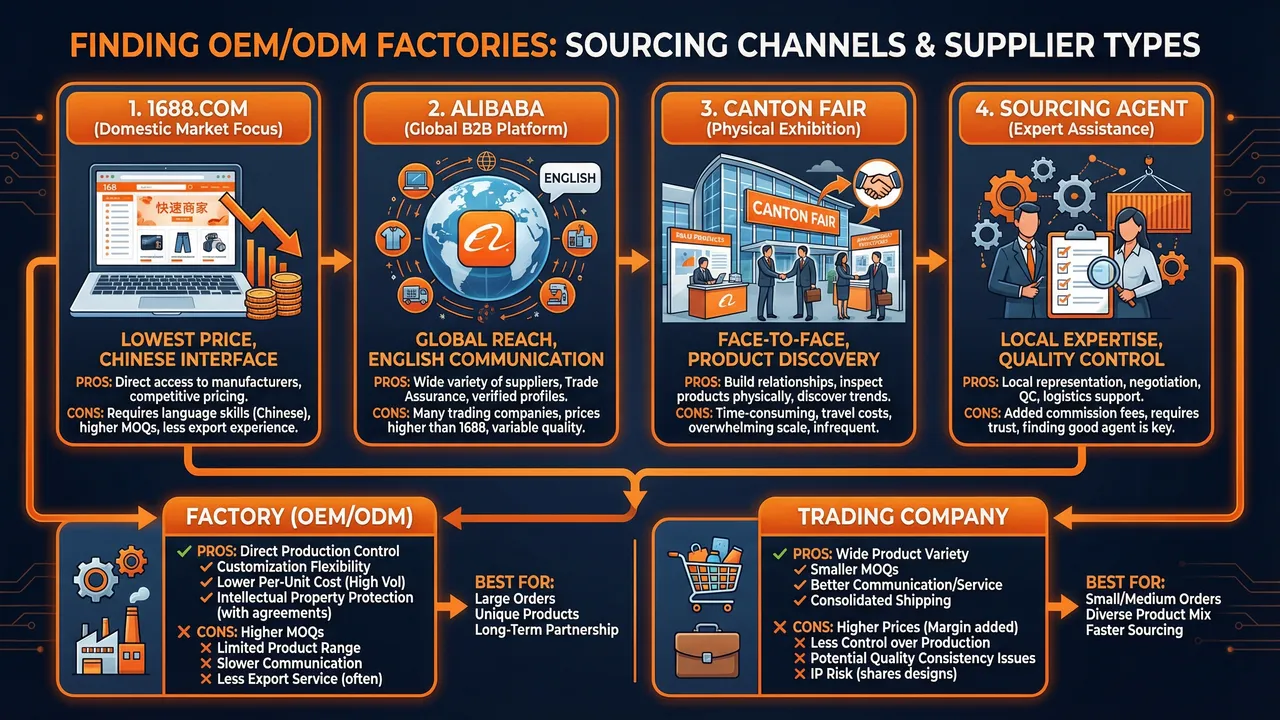
| 1688.com | Lowest prices, direct factories | Chinese | 500+ |
| Alibaba.com | English communication, Trade Assurance | English | 500+ |
| Canton Fair | In-person factory meetings | Chinese/English | Negotiable |
| Sourcing agent | All-in-one (search, samples, QC) | Your language | Varies |
Factory vs Trading Company
For private label, you want factories - not trading companies. Factories control production, can make custom modifications, and offer lower prices.
Red flags that suggest a trading company:
- Products across vastly different categories (toys AND electronics AND clothing)
- Doesn't have factory photos showing production lines
- Located in Shenzhen/Guangzhou/Shanghai (trade hubs, not manufacturing cities)
- Won't allow a factory visit
Read our complete guide to finding suppliers on 1688 for detailed search strategies.
Step 3: Requesting and Evaluating Samples
Sample Request Essentials
Your sample request email/message should include:
- Product reference: Link to the exact listing or product you want
- Modifications requested: Be specific (color Pantone 165C, material upgrade to 304 stainless steel)
- Quantity: "I'd like to order 2-3 samples"
- Your business context: "We sell on Amazon US, monthly volume 500+ units"
- Timeline: "When can samples be ready?"
Sample Costs
| Sample Type | Typical Cost | Who Pays Shipping |
|---|---|---|
| Existing product sample | $0-$10 | Buyer ($20+ via DHL) |
| Modified sample | $20+ | Buyer |
| Custom mold/design sample | $100+ | Buyer |
| Golden sample (production reference) | Included in order | N/A |
Evaluation Checklist
When samples arrive, check:
- Dimensions match your specifications
- Weight matches (weigh on kitchen scale - suppliers swap materials)
- Material quality feels right (no cheap plastic smell, no rough edges)
- Function works perfectly (buttons, zippers, hinges, seals)
- Color matches your Pantone code
- Compare against competitors' products side-by-side
Step 4: Logo and Packaging Design
This is where private label differentiation actually happens. The product might be similar to competitors - the unboxing experience is what makes your brand memorable.
Logo Requirements for Suppliers
Your supplier needs these files:
- Vector format:
.aior.epsfile (for printing, engraving, embossing) - High-res PNG: With transparent background (for packaging mockups)
- Color codes: Pantone for physical printing, HEX/RGB for digital
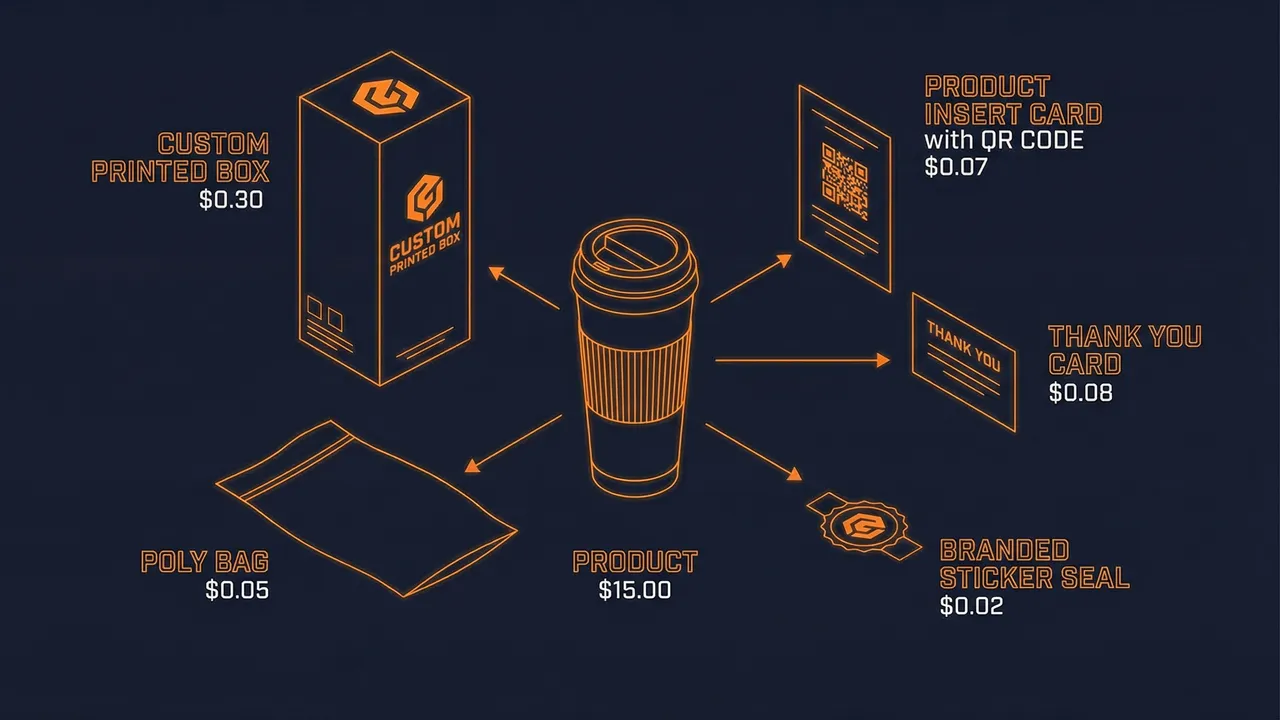
Packaging Components
| Component | Cost Per Unit | Impact | Priority |
|---|---|---|---|
| Custom box (printed) | $0.30+ | High - first thing customers see | Essential |
| Poly bag (branded) | $0.02+ | Medium - product protection | Essential for FBA |
| Insert card | $0.05+ | High - warranty, how-to, review ask | Highly recommended |
| Thank you card | $0.03+ | Medium - personal touch | Recommended |
| Custom tape | $0.01+ | Low - professional feel | Nice to have |
| Sticker seal | $0.01+ | Low - tamper evidence | Nice to have |
Supplymo Insight: The insert card is the highest-ROI packaging element. A well-designed insert card with a QR code linking to a warranty registration page achieves two things: (1) it builds your email list outside Amazon, and (2) it gives unsatisfied customers a place to complain to YOU instead of leaving a 1-star review. We've seen insert cards reduce negative review rates by 30+%. Cost: $0.05/unit. Value: priceless.
Step 5: Negotiating MOQ and Pricing
MOQ Negotiation Tactics
- Start with an ODM product - existing molds = lower MOQ
- Offer higher per-unit price for lower MOQ: "I'll pay $3.80 instead of $3.20 if you can do 500 units instead of 1,000"
- Commit to reorder volume: "First order 500, reorder 2,000 within 3 months"
- Ask for color/size splits: "500 total: 200 black, 200 blue, 100 red" - some factories count total, not per SKU
- Bundle with packaging: Ordering custom packaging through the same factory sometimes lowers the product MOQ
Pricing Tiers
| Order Size | Per-Unit Price | Notes |
|---|---|---|
| Sample (1-3 units) | Retail price | For evaluation only |
| 500 units | $3.80 | Small batch premium |
| 1,000 units | $3.40 | Standard MOQ for most products |
| 3,000 units | $3.10 | Volume discount kicks in |
| 5,000+ units | $2.80 | Best pricing, committed relationship |
Step 6: Creating a Purchase Contract
Your purchase order should include:
- Product specifications: Exact dimensions, materials, weight, color codes
- Quality standards: AQL levels, defect classifications, golden sample reference
- Quantity and pricing: Per-unit price, total amount, payment terms
- Payment terms: 30% deposit via T/T, 70% after pre-shipment inspection passes
- Delivery timeline: Production start date, completion date, shipping date
- Packaging specifications: Box dimensions, printing requirements, insert contents
- Penalty clause: What happens if delivery is late or quality fails
Step 7: Production Oversight and QC
Timeline
| Phase | Duration | What to Do |
|---|---|---|
| Material sourcing | 3-5 days | Supplier orders raw materials |
| Production | 15+ days | Depends on complexity and quantity |
| QC inspection | 1 day | Schedule when 80% complete |
| Packaging | 3-5 days | Custom boxes printed and assembled |
| Ready to ship | N/A | You approve after inspection passes |
QC Strategy for Private Label
For your first private label order, we recommend two inspections:
- During-production inspection (DPI) at 30+% completion - catches systematic issues early
- Pre-shipment inspection (PSI) at 80+% completion - final quality gate
Total QC cost: ~$600 (2 x $300). This is non-negotiable for a first order.
Read our complete quality control guide for AQL tables and checklist templates.
Step 8: Packaging Compliance
Amazon FBA Requirements
- FNSKU barcode: Must be on every unit (covers any existing UPC)
- Suffocation warning: Required on poly bags with opening over 5 inches
- "Made in China" label: Required by US customs on every unit
- Carton labels: Amazon shipment ID, FNSKU, quantity, weight per carton
US Product Compliance
| Product Type | Required Compliance |
|---|---|
| Children's products (under 12) | CPSIA testing, CPC certificate |
| Electronics | FCC certification |
| Food contact items | FDA registration |
| Cosmetics | FDA registration, ingredient listing |
| Textiles | Fiber content label, care instructions |
Step 9: Shipping and Logistics
Choose your shipping method based on the volume threshold guide:
| Shipment Size | Recommended Method | Cost Estimate | Transit Time |
|---|---|---|---|
| 500 units (100 kg) | Air freight | $400+ | 5-7 days |
| 1,000 units (200 kg) | Air, then transition to sea | $600+ | 5-7 days |
| 2,000+ units (400+ kg) | Sea freight (LCL or FCL) | $400+ | 25+ days |
Pro tip for launches: Ship the first 200 units by air freight so you can start selling immediately. Ship the remaining 800 units by sea freight. This "fast-then-slow" strategy gets you to market faster without overpaying for shipping.
Read our complete shipping guide for rate comparisons.
Step 10: Launch Strategy and First Sales
Pre-Launch (2 weeks before inventory arrives)
- Set up Amazon listing with keywords, images, and A+ Content
- Prepare PPC campaigns (auto + manual targeting)
- Set initial price 10+% below target to generate early velocity
Launch Week
- Activate PPC at aggressive bids ($1.50+ per click)
- Send inventory to FBA (ship all to one FC for faster receiving)
- Monitor listing for Buy Box eligibility, keywords, and indexing
Post-Launch (weeks 2-4)
- Optimize PPC bids based on ACoS data
- Gradually raise price toward target as reviews accumulate
- Request reviews via Amazon's "Request a Review" button (compliant method)
- Reorder when you have 30 days of inventory remaining
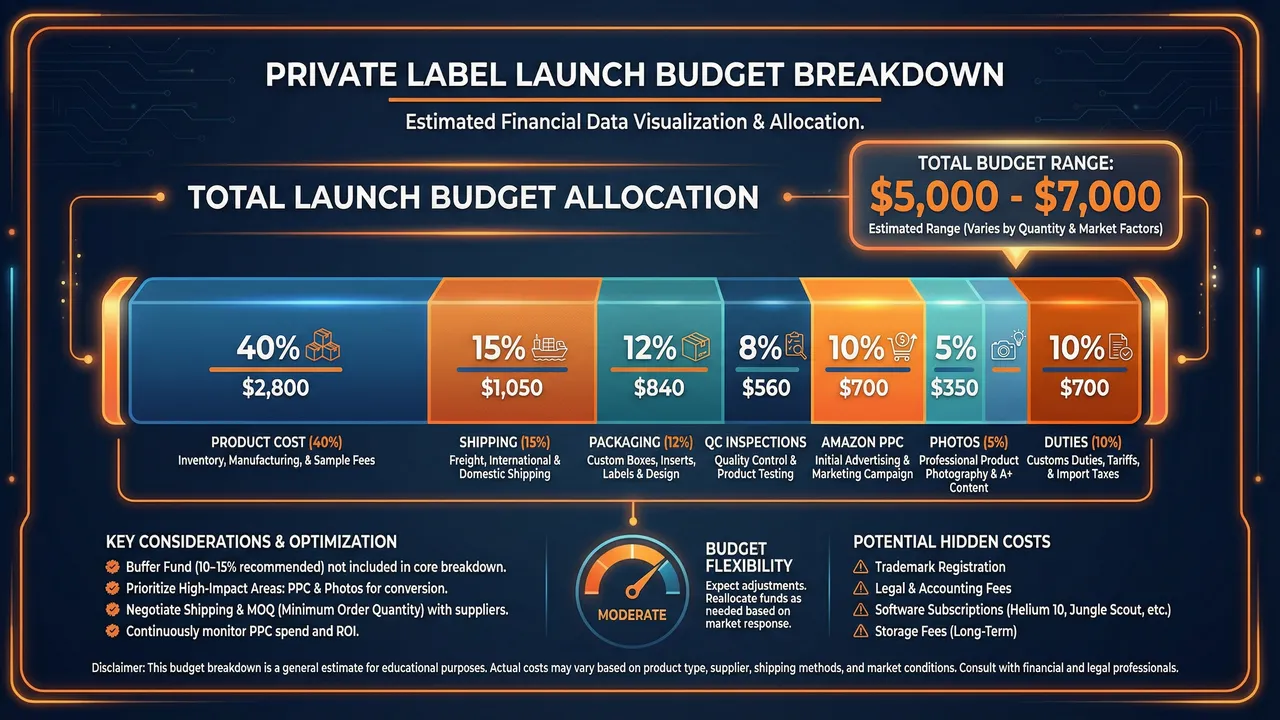
Budget Breakdown: What It Really Costs
| Cost Item | Low End | High End | Notes |
|---|---|---|---|
| Product samples | $50 | $200 | Including shipping |
| Product cost (1,000 units) | $2,500 | $5,000 | Depends on product |
| Custom packaging | $300 | $1,500 | Box + inserts + poly bags |
| Logo and branding | $0 | $500 | Free with Canva, or hire designer |
| QC inspections (2x) | $500 | $700 | During production + pre-shipment |
| Shipping (air freight) | $400 | $1,000 | For first 1,000 units |
| Import duties | $200 | $800 | Depends on HS code |
| Amazon listing photos | $150 | $500 | 7 images (main + lifestyle) |
| Initial PPC budget | $300 | $1,000 | First month advertising |
| Total | $4,400 | $11,200 | N/A |
Supplymo Insight: The sweet spot for a first private label launch is $5,000+. Below $3,000, you're cutting corners that will cost more later (cheap packaging, no QC, no PPC budget). Above $10,000, you're overspending before validating demand. Start with 1,000 units of an ODM product, invest in great packaging and insert cards, and keep 30% of your budget liquid for PPC in the first month. That's the formula that gives you the best odds.
Worked Example: First Private Label Run with Controlled Risk
Assume a first ODM launch with 1,000 units.
| Cost Block | Budget |
|---|---|
| Product + packaging | $4,200 |
| Samples and revisions | $280 |
| QC inspections | $600 |
| Shipping + customs | $1,050 |
| Listing assets + initial ads | $1,200 |
| Total initial capital | $7,330 |
If unit landed cost is $5.25 and retail is $22.99, you have room for ads and early optimization without immediately compressing margin below viability.
Operationally, this setup works best when you freeze specs before mass production and treat insert cards, barcode rules, and carton marks as non-negotiable QC checkpoints.
Before placing deposit, model MOQ sensitivity in MOQ Calculator and align sample approvals via Sample Request.
FAQ
Q: How long does it take to launch a private label product from China?
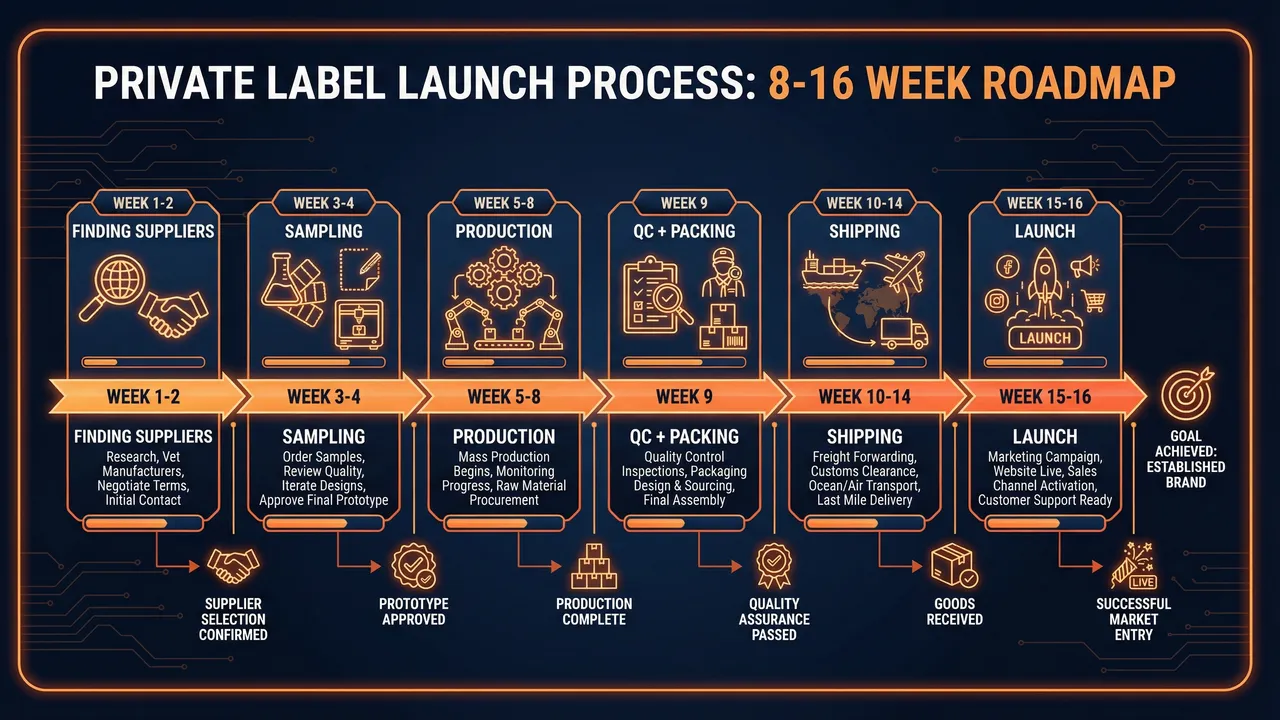
Typically 8+ weeks from first supplier contact to inventory in your warehouse. The breakdown: 1-3 weeks finding suppliers, 1-3 weeks sampling, 2-3 weeks production, 1 week QC + packaging, 1-3 weeks shipping (air vs sea).
Q: What's the minimum budget for a private label product?
You can technically start with $3,000+ using ODM (factory's existing design), low MOQ (500 units), and air freight. But a more realistic budget for a competitive launch is $5,000+.
Q: Should I start with OEM or ODM?
ODM for your first product. It's faster, cheaper, and lower risk. You can always move to OEM for your second product once you understand the market and have cash flow.
Q: How do I protect my product design from being copied?
File a design patent in your target market, register your trademark, and enroll in Amazon Brand Registry. In China, utility model patents (utility model patent) are relatively cheap ($500+) and provide 10 years of protection. Also consider an NNN agreement (Non-Disclosure, Non-Use, Non-Circumvention) with your factory.
Next Steps
Try: MOQ Calculator and Sample Request.
Need execution support for your first order? Talk to Supplymo.
Launching a private label product is the highest-margin path in e-commerce - but only if you get the sourcing, quality, and packaging right.
Find ODM factories ready to customize for your brand
Already have a product idea? Start with our Import Duty Calculator to estimate your landed cost and confirm your margins work.