
HS classification via CBSA
The Canadian Customs Tariff sets the HS line and duty rate. Country of origin and classification together decide the duty owed at the border.
Ask Supplymo
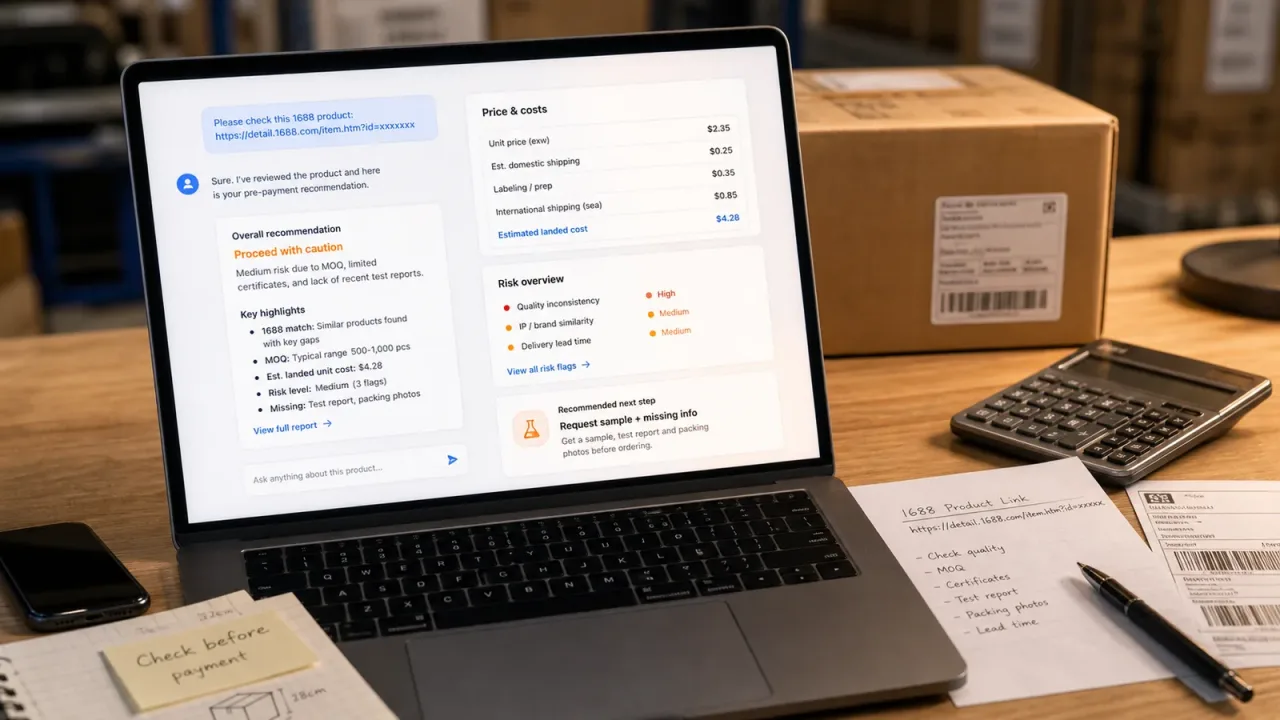
Sourcing decisions before supplier payments
Ask anything about buying from 1688 — answers from our sourcing operations, with verified official sources when available, before you pay.
Curated questions buyers ask before payment
Curated prompts are editorial examples, never raw customer questions. Official sources appear only when a verified source is available.
Canada checklist
Importing from 1688 into Canada means a CBSA classification, GST plus provincial tax, and bilingual labelling that the supplier price never reflects.
The Canadian Customs Tariff sets the HS line and duty rate. Country of origin and classification together decide the duty owed at the border.
Federal GST (and HST or PST depending on the province) applies on import. The total tax burden varies by where the goods are delivered.
Many consumer goods need English and French labelling, and electronics or radio products fall under ISED Canada requirements.
Commercial shipments usually need a broker to file the CBSA release. Missing data on value or origin can stall the shipment.
Curated Answer Bank
Each answer comes from Supplymo’s maintained sourcing knowledge, keeps the uncertainty visible, and points to the evidence or next tool needed before payment.
Decide what visible supplier signals can and cannot prove before money moves.
4 curated answers
Yes. Supplymo can review the product link, quantity, destination, visible risks, and quote readiness before you pay a 1688 supplier.
Boundary: Final customs, certificates, supplier performance, and delivery outcomes need review and cannot be guaranteed.
Next step: Submit the product link for Product Check.
Send the product link or keywords, target quantity, destination country, SKU/options, and any shipping, labeling, repacking, or photo needs.
Boundary: Missing quantity or destination makes cost and shipping answers low confidence.
Next step: Send the missing fields or use the Submit product form.
Supplymo can review visible supplier signals, listing consistency, MOQ, price tiers, package readiness, and questions that should be confirmed before supplier payment.
Boundary: Visible platform signals reduce uncertainty but do not guarantee supplier quality, delivery behavior, refunds, or after-sales outcome.
Next step: Submit the supplier and product link for pre-payment review.
Sample first is recommended when product quality, material, size, packaging, compliance, or supplier reliability is uncertain.
Boundary: A sample does not guarantee every bulk unit will match.
Next step: Ask for sample-first review.
Expose the inputs a cheap listing price leaves out, without pretending an estimate is a quote.
4 curated answers
No. The 1688 unit price excludes many possible costs such as MOQ, domestic shipping, warehouse handling, prep, international shipping, duties, taxes, and local delivery.
Boundary: Final cost requires quote and official import review where relevant.
Next step: Use landed cost check before payment.
Missing package size, weight, quantity, destination, product category, HS code, or restricted-product signals makes the estimate low confidence.
Boundary: Low confidence estimate should not be used for payment decision alone.
Next step: Collect missing fields first.
Destination, quantity, carton count, carton dimensions, gross weight, product type, risk flags, and preferred route are needed for shipping readiness.
Boundary: Without package data, freight estimate is low confidence.
Next step: Ask supplier for carton data.
Treat shipping as low confidence until package data is confirmed by supplier or measured after warehouse receipt.
Boundary: Guessing package size can distort shipping cost.
Next step: Ask supplier first; measure at warehouse if needed.
Separate useful preparation from claims that still need product, document or official review.
5 curated answers
Yes. Photos can help verify product, carton, label, package condition, and shipment readiness before goods leave China.
Boundary: Photos are basic evidence, not full inspection guarantee.
Next step: Request photo evidence in quote.
Useful evidence includes product photos, carton photos, labels, count sheet, defect notes, package dimensions, and timeline events.
Boundary: Evidence scope affects cost and timing.
Next step: Choose evidence required in Product Check.
No. Supplymo can prepare a pre-payment risk check and collect required details, but final customs treatment depends on official review.
Boundary: No guaranteed clearance.
Next step: Submit for manual review if customs risk exists.
Batteries, wireless, cosmetics, food contact, children products, medical/health claims, liquids, powders, magnets, branded/IP items, and oversized or fragile goods need review.
Boundary: Review does not guarantee acceptance.
Next step: Mark manual review before quote.
It should include source evidence, product/SKU summary, cost breakdown, missing fields, risk tags, confidence level, quote expiry, and next step.
Boundary: A total-only quote is low trust.
Next step: Request itemized quote.
These are editorially selected Answer Bank cards, not customer chat logs. Estimates and high-risk cases still require current product, route and official-source review.
How it works
Questions are embedded and matched against the curated Supplymo answer bank, including market-specific cards when available.
The assistant does not promise fixed duty, tax, freight, clearance, supplier quality, delivery time, or platform approval.
Missing links, quantity, destination, package data, and restricted-product signals are routed to Product Check or Contact.
FAQ
Output: Written decision record, not a fake final quote.
Handoff: Human review when facts are missing or risk is high.
Start with the decision you are trying to make
The assistant is useful when the question is concrete: what is missing, what could change cost, what risk needs review, and what should happen before supplier payment.